


Imagine finding a song or audio clip on YouTube that you want to use in GarageBand or a digital audio workstation (DAW). AIFF is commonly used for uncompressed PCM audio, making it suitable for editing and further processing. However, converting audio to AIFF does not improve the original source quality or restore data lost through lossy compression.
You can convert authorized YouTube audio through an online workflow or use desktop software to process supported YouTube Music tracks and existing local media files. This guide covers the available methods and explains how to choose appropriate audio settings for your project. Keep on reading!
Way 1. Convert YouTube to AIFF Online Free
If you're looking for a free online solution to convert YouTube to AIFF, you may be disappointed to find that there is no direct YouTube to AIFF converter free. Instead, you'll need to take an extra step—first convert YouTube to MP3, then convert MP3 to AIFF using another tool.
YTMP3 is an intuitive tool that lets you download YouTube videos as MP3 files without signing up. It supports videos up to 240 minutes long, with MP3 downloads capped at 192 kbps. Once you've downloaded the MP3 file, you can use TuneFab's Format Converter to convert it to AIFF for GarageBand or DAW editing.
Note: Remember that converting an MP3, AAC, or other lossy source to AIFF does not restore audio data discarded during the original encoding. The conversion changes the output format, not the quality of the original source.
Step 1. Open YouTube in your browser and find the video you want to convert. Click the Share button and copy the video URL.
Step 2. Go to YTMP3. Paste the copied URL into the input box. Select "MP3" and click "Download".
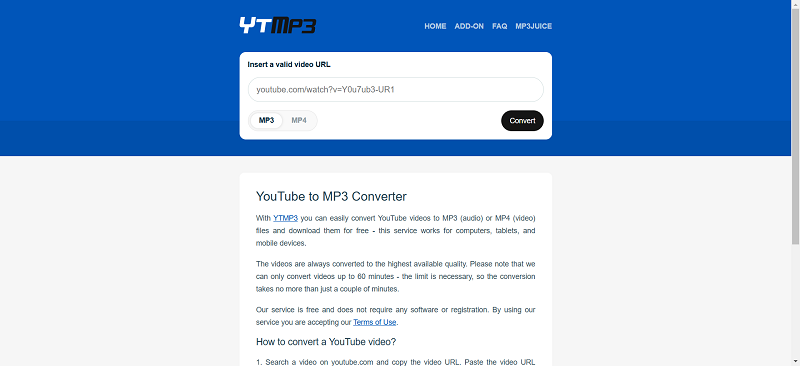
Step 3. When it finishes parsing the URL, you will see the URL in the search box change to "completed". Now hit the download button again to save the MP3 file to your computer.
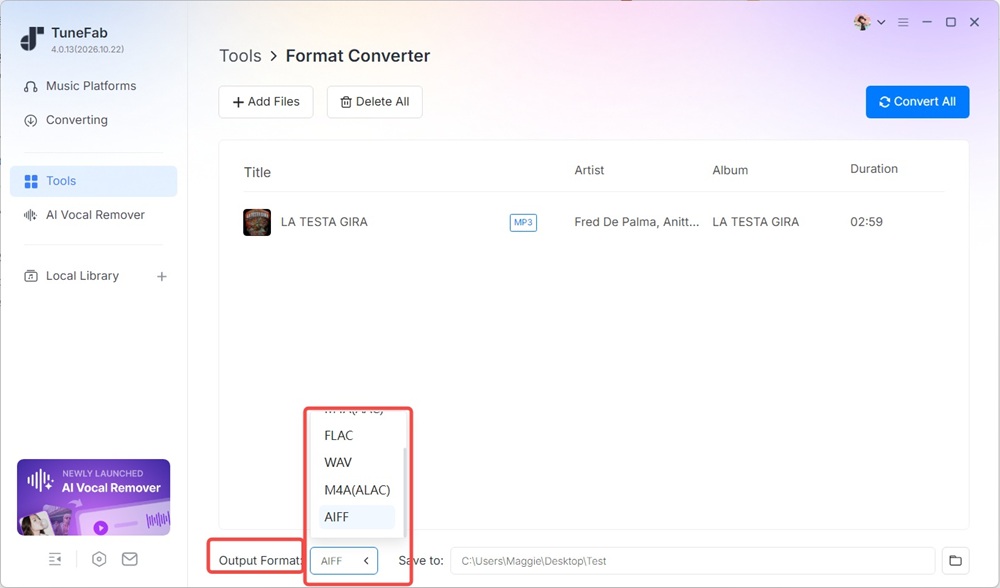
Step 4. Open TuneFab, go to "Tools", then enter the Format Converter. Hit "Add Files" to add the MP3 file.
Step 5. Select the Output Format as "AIFF" at the bottom left and click "Convert All" on the top right to get the AIFF version.
Way 2. Convert YouTube to AIFF in Batch with TuneFab Converter
Unlike Way 1, which focuses on converting YouTube videos to AIFF, this method is specifically for converting YouTube Music tracks to AIFF for use in GarageBand, DAWs, and other audio-editing software.
TuneFab YouTube Music Converter provides a desktop workflow for selecting supported songs and converting them to AIFF in batches. Its built-in YouTube Music web player lets you browse tracks within the program instead of copying individual URLs. After you sign in to your YouTube account in the built-in player, playlists from the main YouTube site are also displayed and available for download, so you can work with supported music playlists from both YouTube and YouTube Music.
This option is useful when you need to prepare multiple files for an editing project, although converting lossy audio to AIFF does not restore audio data lost during compression.
Why Choose TuneFab YouTube Music Converter?
- AIFF Output – Convert supported YouTube Music tracks to AIFF for compatible audio-editing workflows.
- Built-in YouTube Music Web Player – Browse and add songs directly, no need to copy-paste links.
- Customizable Output Settings – Adjust available audio parameters and file organization to suit your workflow.
- Convenient File Management – Locate converted files and import them into your preferred editing software.
Now, let's move to the steps of downloading YouTube music with TuneFab.
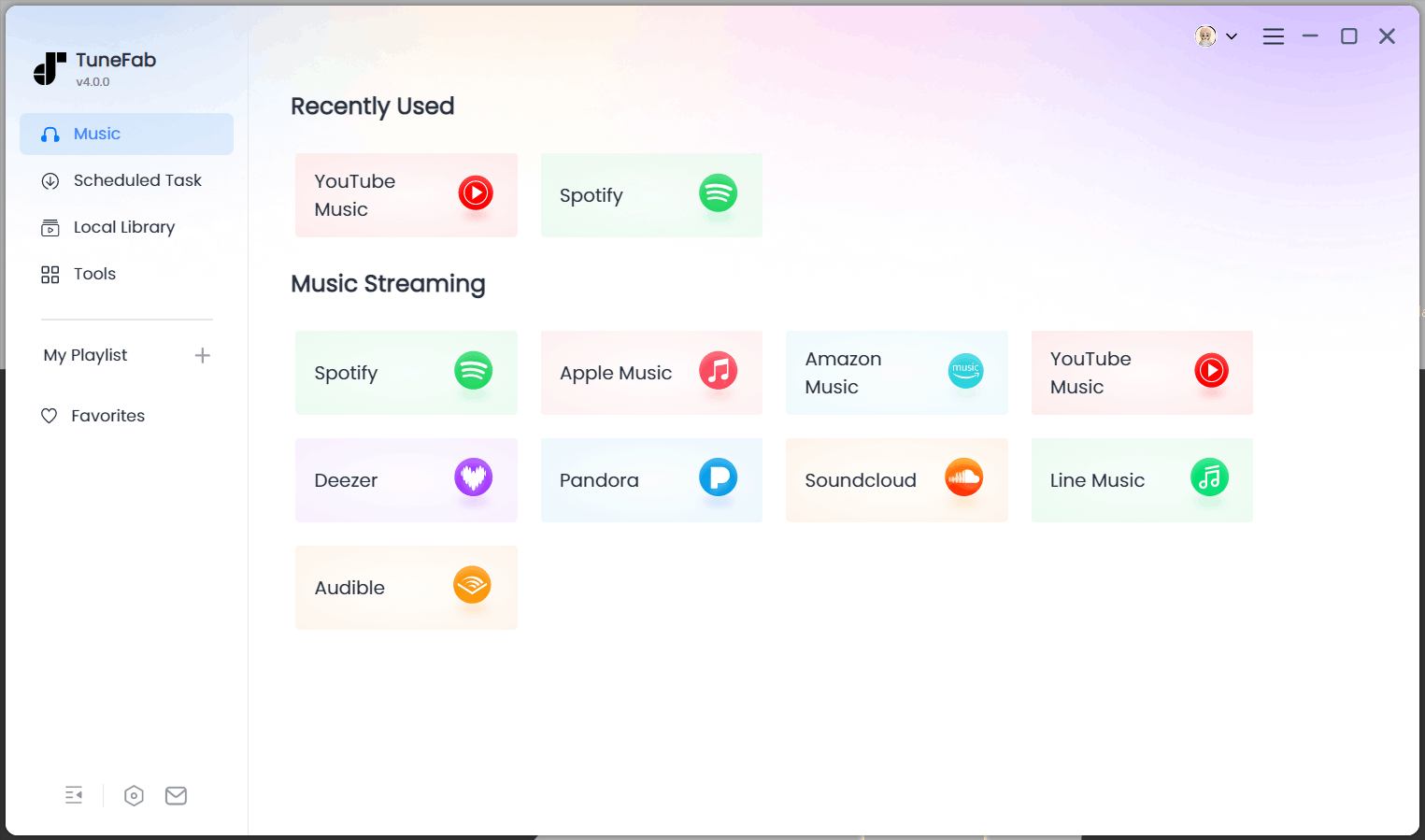
Step 1. Open the software and set YouTube Music as your source platform.
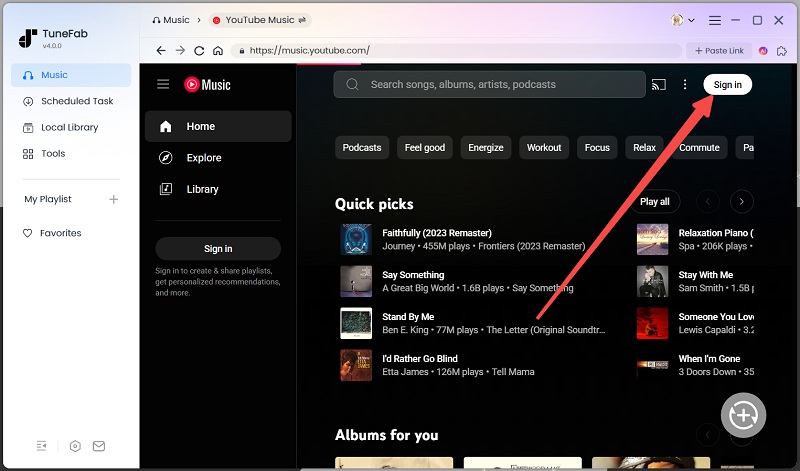
Step 2. Log into your YouTube Music account through TuneFab’s built-in browser to access your library. If you are just downloading a single song, you can also choose not to log in to it.
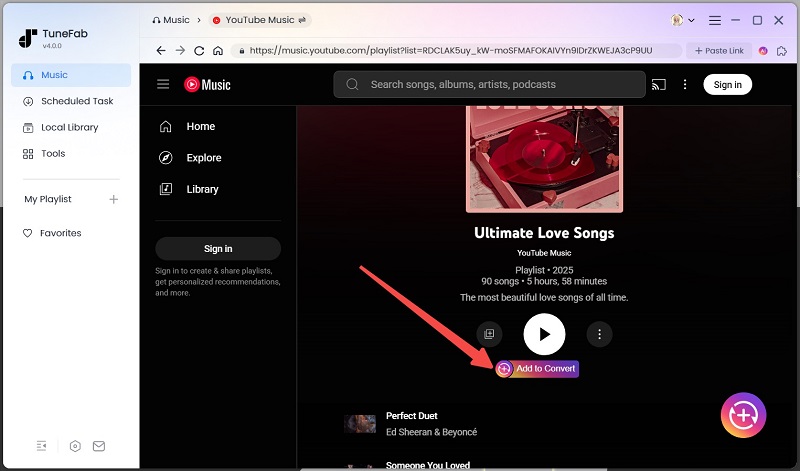
Step 3.Find the tracks you want and hit the "Add to Convert" button to prepare them for downloading.
Step 4. Choose AIFF as your output format. Where available, preserve the source audio parameters or match the sample rate, bit depth, and channel configuration required by your DAW project. Selecting a higher bit depth does not restore audio information lost in the original source.
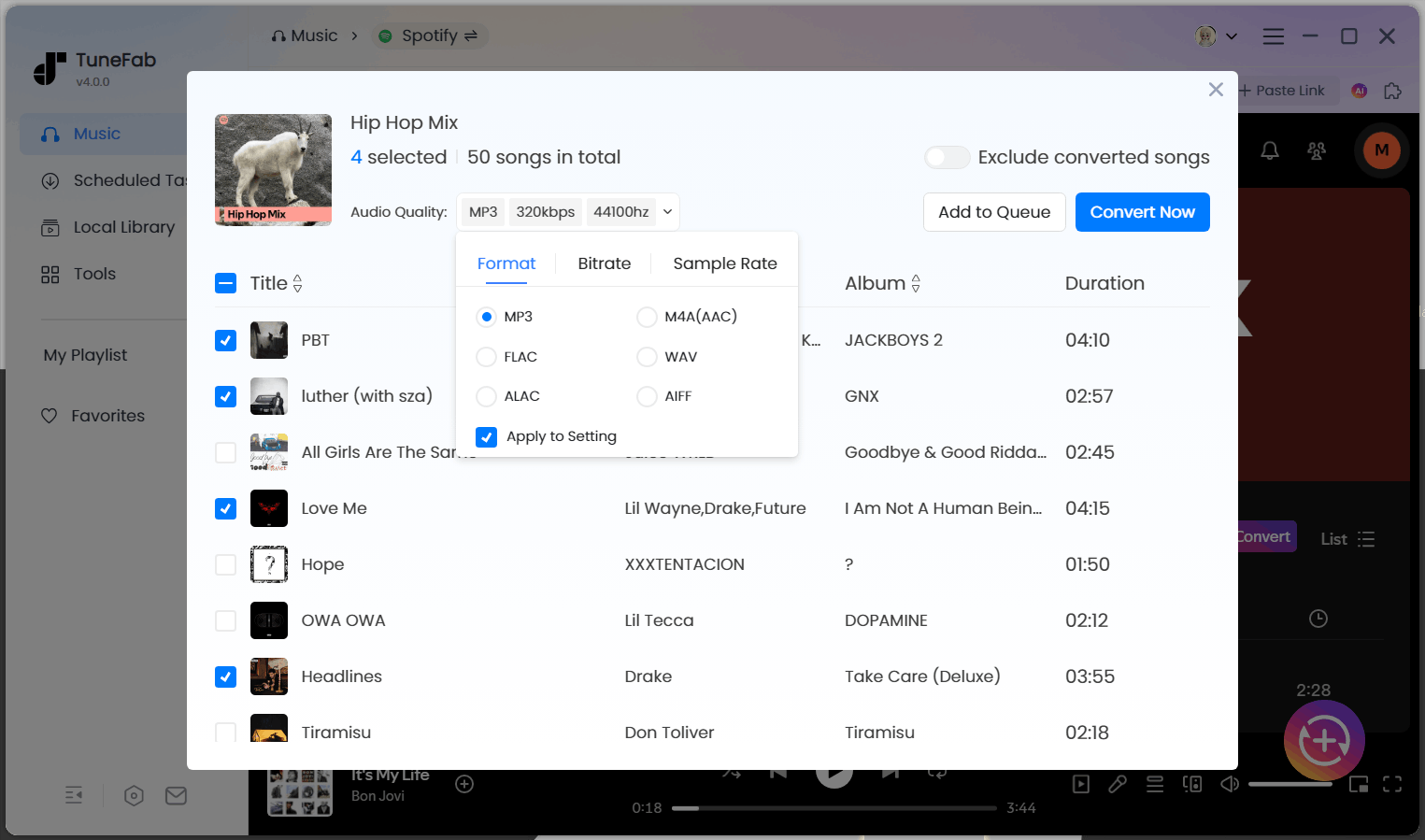
Step 5. Click the Convert All button to begin processing the selected files into AIFF format.
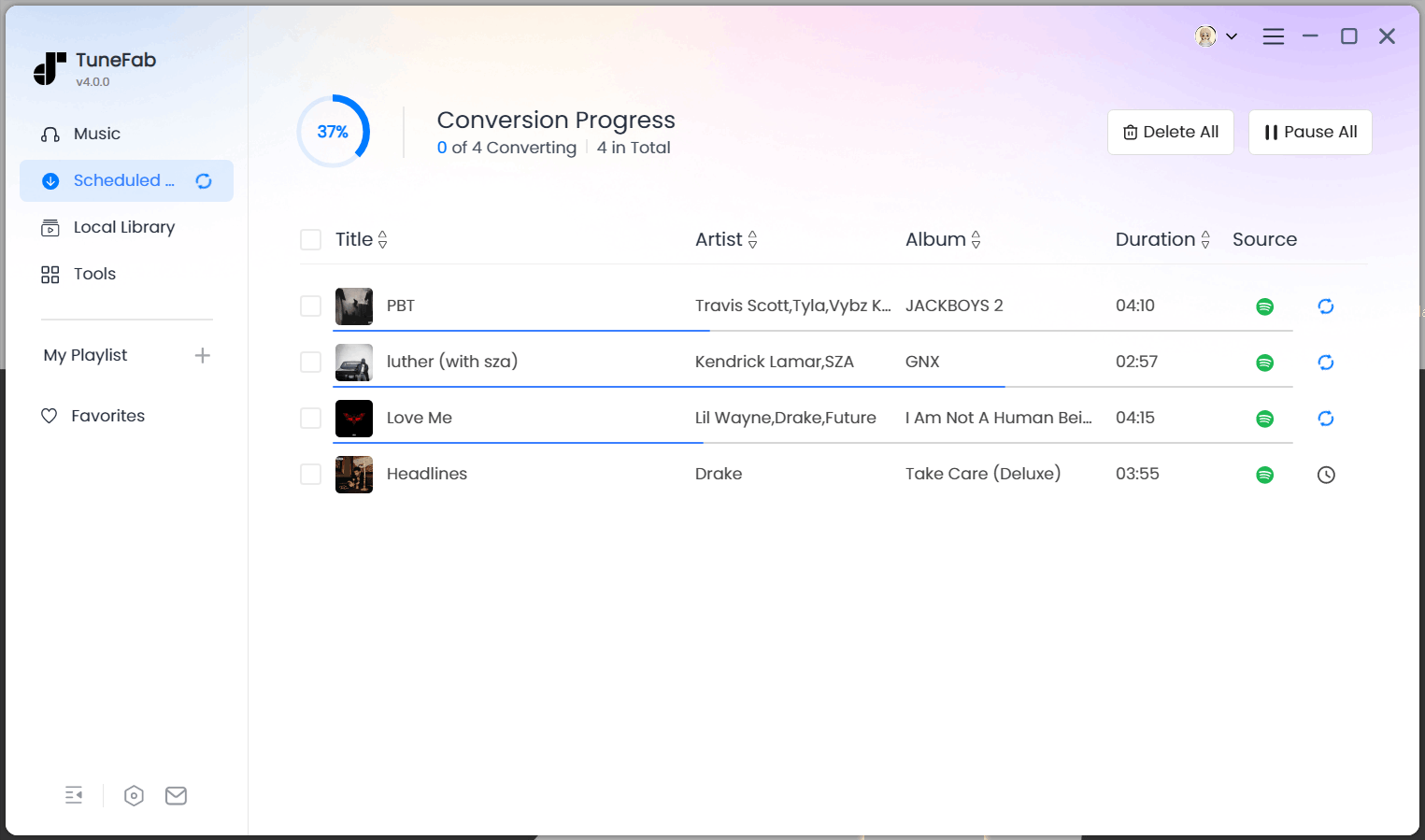
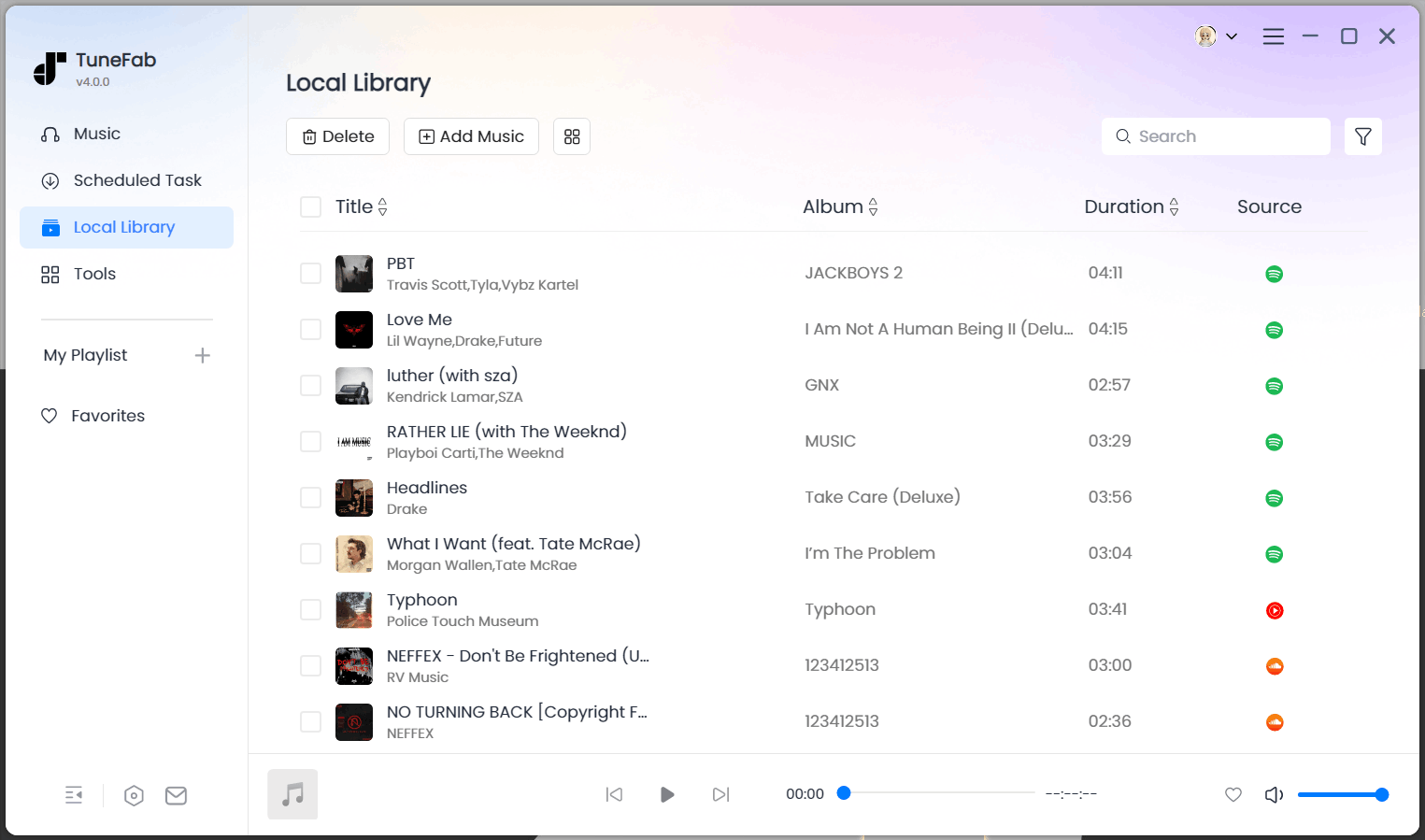
Step 6. Once finished, navigate to the Finished section to find your converted AIFF files. Check the output properties before importing them into GarageBand or another DAW.
AIFF vs. WAV, FLAC, and ALAC: Which Format Should You Choose?
AIFF is not automatically better in sound quality than WAV, FLAC, or ALAC. The best choice depends on your editing software, file-size requirements, and whether you need uncompressed audio or lossless compression.
| Format | Audio characteristics | File size and typical use |
| AIFF | Commonly stores uncompressed PCM audio | About 10 MB per minute for 16-bit/44.1 kHz stereo PCM; useful for editing workflows that support AIFF |
| WAV | Commonly stores uncompressed PCM audio and is functionally similar to AIFF for standard PCM audio | About 10 MB per minute at the same settings; widely used for recording and DAW projects |
| FLAC | Lossless compression that preserves the encoded audio data | Usually smaller than uncompressed PCM; useful for lossless storage and archiving |
| ALAC | Apple Lossless compression that preserves the encoded audio data | Usually smaller than uncompressed PCM; useful for lossless storage in compatible Apple-oriented workflows |
The AIFF and WAV size estimates assume uncompressed 16-bit, 44.1 kHz stereo PCM. Actual file sizes vary with duration, sample rate, bit depth, and channel count.
For GarageBand and DAW editing, choose AIFF or WAV when your workflow calls for uncompressed PCM files. If storage efficiency is more important, FLAC or ALAC can preserve lossless audio in a smaller file when supported by your software. If the original YouTube audio is lossy, converting it to any of these formats will not restore the data already lost.
For a smaller compressed output, you can also consider converting YouTube audio to FLAC or converting YouTube audio to M4A, depending on your source and intended use. FLAC and ALAC are lossless formats, while M4A may contain lossy AAC or lossless ALAC audio.
FAQs About YouTube to AIFF
What Is AIFF Format and Why Should I Use it for YouTube Audio Conversion?
AIFF (Audio Interchange File Format) is a high-quality, uncompressed audio format developed by Apple in 1988. Unlike MP3 or AAC, AIFF retains all audio data, ensuring lossless sound quality. This makes it an excellent choice for music production, editing, and long-term storage.
AIFF commonly stores uncompressed PCM audio, which makes it suitable for music production and editing. However, the file extension alone does not guarantee that the audio is uncompressed, and converting compressed YouTube audio to AIFF does not restore data lost during compression. Its main advantage is providing an editing-friendly format when your software supports it.
Does Converting YouTube Audio to AIFF Improve Sound Quality?
No. Converting a lossy source such as AAC or Opus to AIFF does not restore the audio information discarded during compression. The resulting file may use uncompressed PCM, but its quality remains limited by the original source.
Is AIFF Better Than WAV for DAW Editing?
Neither format is inherently better-sounding when both contain the same PCM audio with matching sample rate, bit depth, and channel configuration. Both can be suitable for DAW editing; choose the format supported by your software and required by your project.
Will Converting YouTube Audio to AIFF Preserve Song Titles and Artist Names?
Not necessarily. Whether song titles, artist names, album information, and other metadata are preserved depends on the source file and the converter's metadata support. After conversion, check the AIFF file's tags and update any missing information before organizing your audio library or importing the file into another application.
Conclusion
Converting YouTube audio to AIFF can make it easier to prepare audio files for GarageBand, DAWs, and other editing workflows. In this guide, we covered two methods: using YTMP3 to download YouTube videos as MP3 files and then converting them to AIFF with TuneFab Format Converter, or using TuneFab YouTube Music Converter to convert supported YouTube Music tracks directly to AIFF.
Choose the method that fits your audio source, and check the output settings to ensure the files are suitable for your editing project. Remember that converting lossy audio to AIFF does not restore lost audio data, but it can provide a convenient format for further processing.

