


If you want to add YouTube Music tracks to your local music library, play them in compatible music players, or manage your music files across Apple devices, M4A is a practical format to consider. It supports AAC for efficient compression and smaller file sizes, as well as ALAC for lossless encoding. The right option depends on your playback needs and the quality of the original audio.
This guide covers how to convert YouTube Music to M4A with desktop and online tools, explains the differences between AAC and ALAC, and helps you choose the right output settings.
Before You Convert: Understanding M4A, AAC, and ALAC
M4A is a file container based on the MPEG-4 audio format. It can hold audio encoded with different codecs, most commonly AAC or ALAC. The container determines how the audio and its metadata are stored, while the codec determines how the audio is encoded.
- M4A with AAC: AAC is a lossy codec that reduces file size while maintaining good perceived audio quality. It is a practical choice for everyday listening, streaming-derived music, and portable devices.
- M4A with ALAC: Apple Lossless Audio Codec (ALAC) compresses audio without losing information relative to the audio supplied to the encoder. It is useful when you need a lossless copy of an available source, but it cannot recover detail missing from a lossy AAC or Opus stream.
- M4A with AAC through stream copy: If the source audio is already AAC and the tool supports stream copying, it may be possible to place the existing audio stream into an M4A container without re-encoding. This preserves the encoded audio stream, but it is not available for every source or converter.
For YouTube Music, the source stream may use AAC or Opus, depending on the delivery conditions. If a converter decodes that audio and encodes it as AAC or ALAC, it performs a new encoding step. Check the actual output codec and file properties instead of assuming that selecting M4A means the original stream was copied unchanged.
Note: M4A is widely supported across iPhone, iPad, and Mac, and it also plays in many modern Windows and Android apps, including VLC. MP3 remains a sensible choice for older hardware or devices with limited codec support. ALAC and FLAC are both lossless codecs, but compatibility depends on the device and playback software.
For a broader comparison of lossless formats, see our guide to converting YouTube Music to FLAC. If smaller files and broad compatibility matter more, our YouTube Music to MP3 guide explains the alternatives.
How to Choose M4A Settings
When selecting M4A output settings, consider the following factors:
| Factor | What it means | Recommendation |
| Codec | AAC is lossy; ALAC is lossless | Choose AAC for smaller files and ALAC when lossless encoding is needed. |
| Bitrate | The amount of encoded audio data per second | Higher AAC bitrates may reduce compression artifacts, but cannot restore detail missing from the source. |
| Sample rate | The number of audio samples per second | 44.1 kHz is common for music. A higher sample rate does not automatically improve fidelity. |
| File size | Affected by codec, bitrate, duration, and channels | AAC generally requires less storage than ALAC for the same duration. |
| Compatibility | Support varies by device and playback software | AAC in M4A is a practical choice for Apple devices and many modern cross-platform players. MP3 may suit older hardware better. |
YouTube Music lists AAC and Opus at up to 256 kbps for its highest standard audio-quality setting. Converting this source to 320 kbps AAC or ALAC does not increase the original audio detail. A larger output file may simply reflect a different encoding format or settings.
1. Convert YouTube Music to M4A(AAC/ALAC) with TuneFab Converter
If you are searching for an efficient way to download YouTube Music to M4A, TuneFab YouTube Music Converter should be your first choice without question. This program is designed for people who seek a quick and easy approach to dealing with YouTube Music.
Whether you're a music lover or a pro, you can find the perfect solution with TuneFab YouTube Music Converter. It allows you to convert YouTube Music to M4A or any other formats quickly, bringing you an excellent experience in music organizing.
Major features of TuneFab YouTube Music Converter
- Flexible Output Formats: Convert supported YouTube Music content to M4A and other available formats, including MP3, FLAC, WAV, and AIFF. For M4A, choose AAC for efficient lossy audio or ALAC when you need a lossless-encoded output.
- Audio Quality Options: Output quality depends on the source, selected codec, and conversion settings. A higher bitrate or ALAC output cannot recreate audio information that was absent from the source.
- Batch Conversion: Add multiple tracks and process them together, which is convenient for managing larger music selections.
- Built-in YouTube Music Player: Browse and select supported music within the program rather than switching repeatedly between applications.
- Music Library Management: Use the available format and file-management options to organize exported music for compatible players and music libraries.
Keep in mind that exporting a file does not automatically grant permission to copy or redistribute copyrighted music. Check the applicable service terms and ensure you have the necessary authorization.
Step 1. Download TuneFab YouTube Music Converter and launch it on your device.
Step 2. Select the "YouTube Music" service on the first-seen page. Then, sign in via your YouTube Music account.
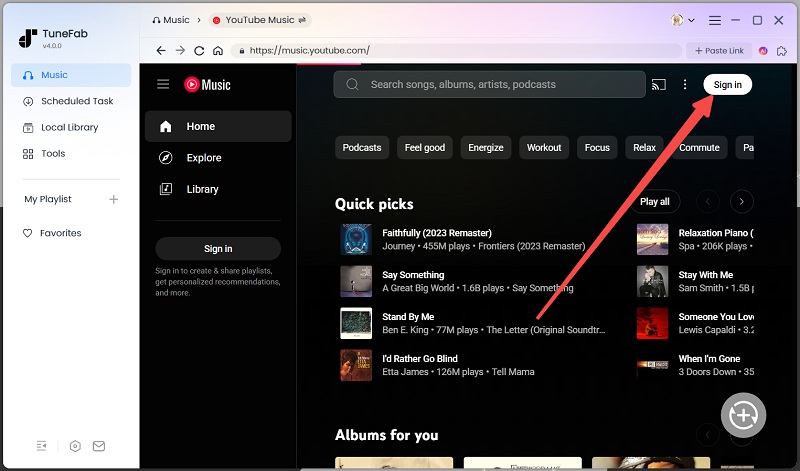
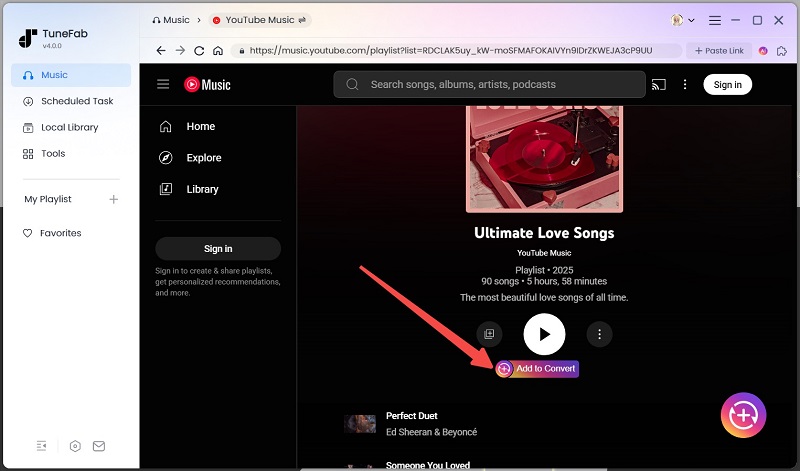
Step 3. Add your target music by clicking the plus icon button or dragging it into the program. Batch processing is also available.
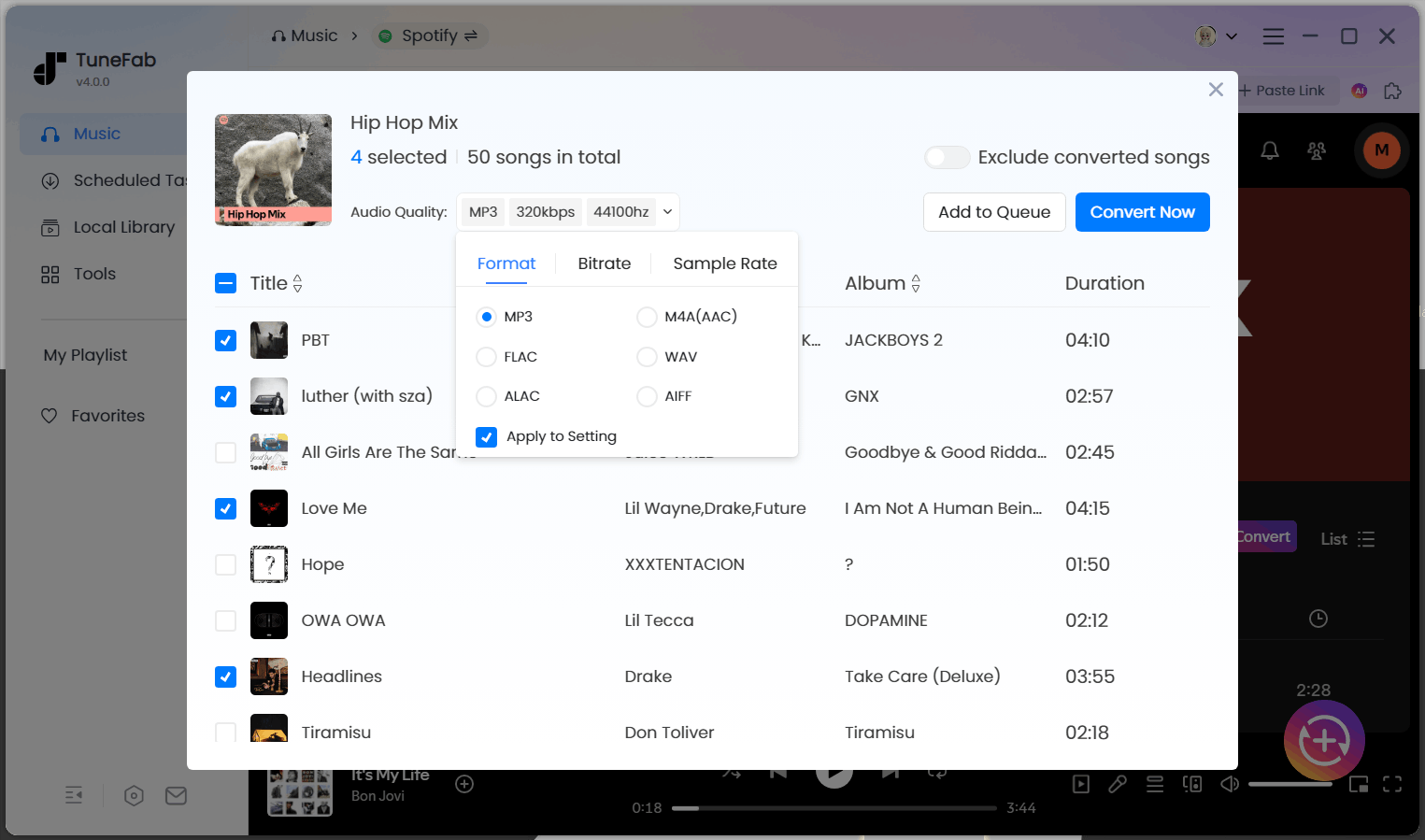
Step 4. On the processing page, select your output format as M4A. Choose the output format as AAC/ALAC.
Before choosing an output format, consider what the resulting file is for. AAC is generally the practical option for everyday listening and smaller files. ALAC is useful when you specifically need lossless encoding, but it does not improve the quality of a lossy YouTube Music source.
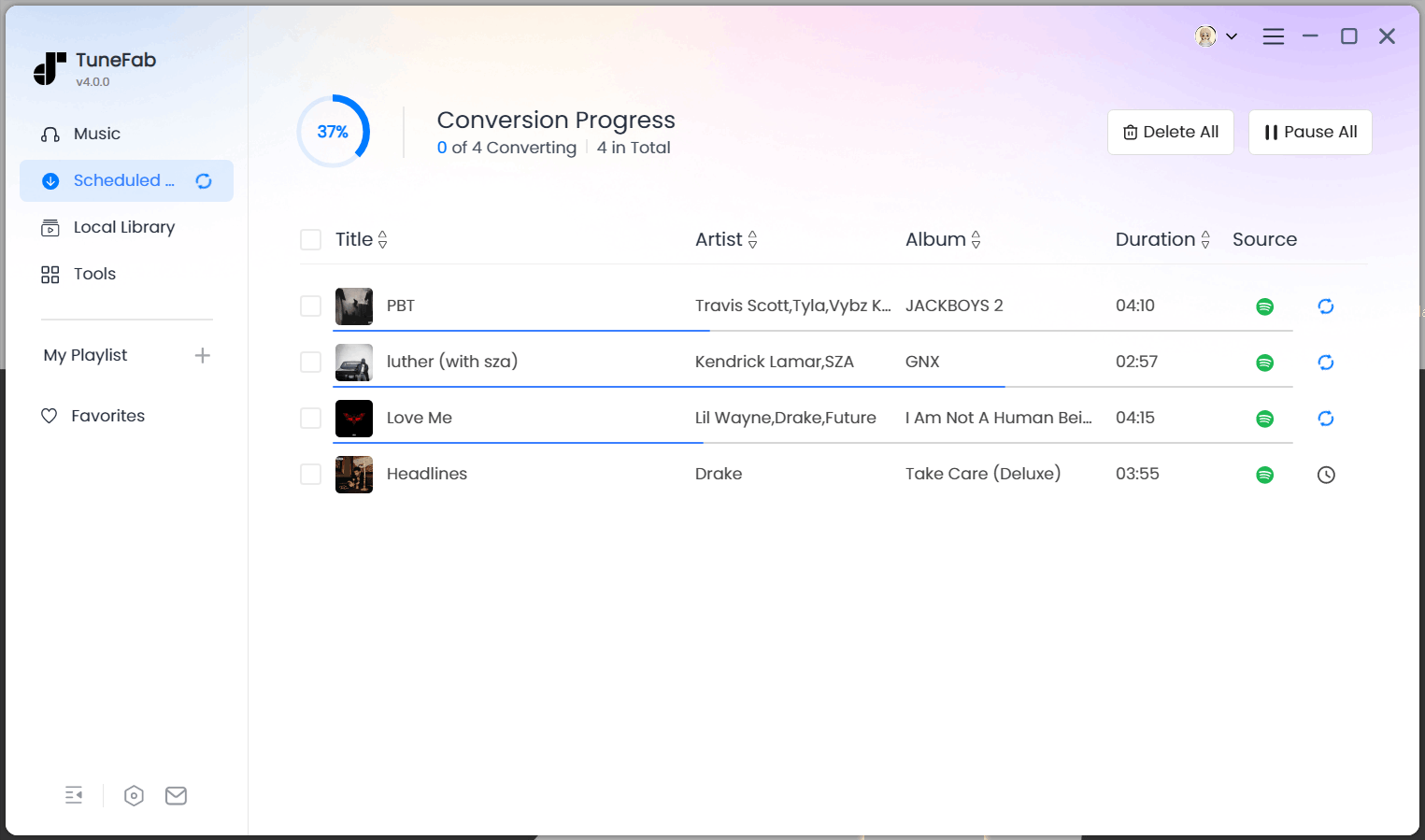
Step 5. Click the "Convert All" button and all the uploaded music will be downloaded automatically.
Read Also:
2. Convert YouTube Music to M4A Online Free with AnyUkit
AnyUkit is a browser-based converter that supports links from both YouTube Music and regular YouTube videos. It offers a simple way to convert a music track to M4A without installing desktop software or creating an account. The tool also supports other output formats, including MP3, MP4, and WAV, making it useful when you need a quick conversion for a specific track. Since it runs in a browser, you can access it on a computer or a mobile device.
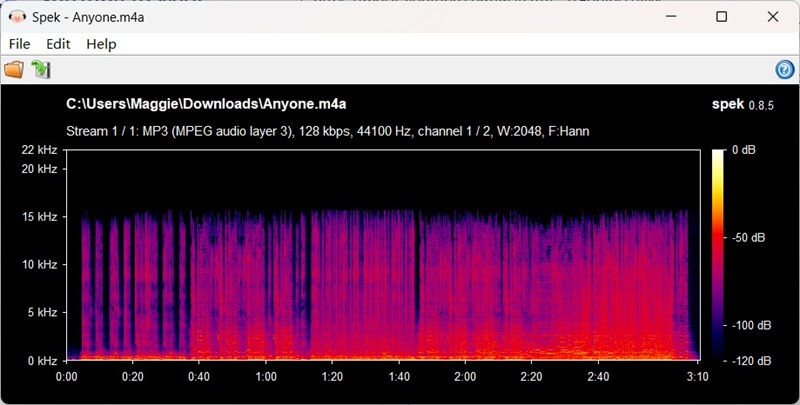
However, AnyUkit has some limitations. Ads may appear during the conversion process, and the available audio quality may be lower than you expect. In our test, the downloaded M4A file measured 128 kbps at a 44.1 kHz sample rate, despite the download page listing 129 kbps. This makes it more suitable for casual listening than for users who need higher-bitrate output. Also, the M4A extension alone does not confirm whether the audio uses AAC or another codec, so check the file properties if codec information matters to you.
Step 1. Visit the AnyUkit website. Copy the URL of the YouTube Music track or regular YouTube video you want to convert, then paste it into the input field.
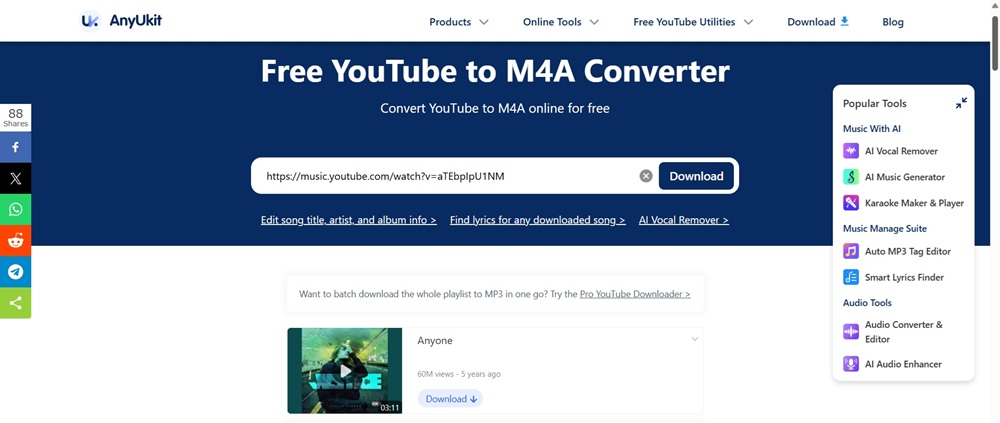
Step 2. Click the "Download" button on the right and wait for the processing. Depending on the source and the tool's current behavior, processing may take some time.
Step 3. Once the available download options appear, find the M4A option and click its corresponding Download button to save the audio file.
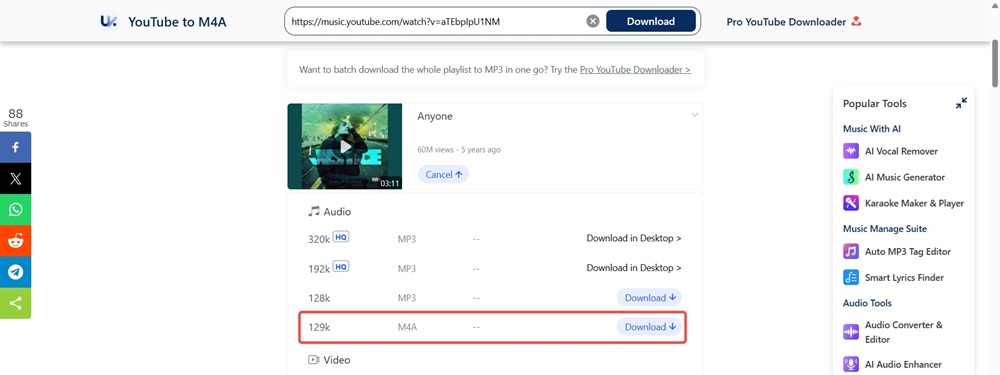
After downloading, check the file's audio properties with a media-information tool. In our test, the download page listed 129 kbps, while the resulting M4A file showed 128 kbps and a sample rate of 44.1 kHz.
Note: The M4A extension does not tell you which codec the file contains.
FAQs About YouTube to M4A
Is M4A Better than MP3?
Not necessarily. M4A is a container, whereas MP3 is an audio format. M4A files commonly use AAC, which can provide good perceived audio quality at relatively low bitrates. MP3 offers extremely broad compatibility, including with older devices.
The result depends on the codec, bitrate, encoder, and source audio. Converting an existing MP3 file to M4A does not improve its original quality. Choose AAC in M4A for efficient everyday listening, or MP3 when compatibility with older hardware is the priority.
Is M4A Lossless?
It depends on the codec. M4A containing AAC is lossy, while M4A containing ALAC uses lossless encoding. Even when a converter exports a lossy source as ALAC, it cannot recover information that was already lost during the original compression.
What Is a Safe YouTube to M4A Converter?
Generally, desktop software is more reliable than an online tool which usually comes with disturbing ads. You should pick a widely trusted brand. Also review the software's privacy practices, download source, and output options. Avoid suspicious download prompts and never enter your Google account password into an untrusted third-party website. No converter can guarantee that every download is safe or authorized.
Can You Convert YouTube Music App Downloads to M4A?
No. Although you can download music in the YouTube Music app for offline listening, these downloads are managed within the app rather than saved as regular, accessible audio files. YouTube Music streams may use AAC or Opus audio codecs, depending on delivery conditions, but the exact format of the app's offline downloads is not publicly specified. Therefore, you cannot directly convert these downloads to M4A using a standard audio converter.
Why Won't My M4A File Play in a Music Player?
An M4A file may fail to play because the player does not support its audio codec, the file is incomplete, or the download was unsuccessful. Try opening it in a player such as VLC to check whether the issue is specific to your original app. If the file still won't play, verify its codec and file integrity before converting or downloading it again.
Conclusion
Converting YouTube Music to M4A lets you save audio in a format compatible with many Apple devices and music apps. TuneFab YouTube Music Converter is worth considering if you need batch conversion and a choice of AAC or ALAC encoding, while AnyUkit offers a browser-based option for converting links from both YouTube Music and regular YouTube videos without installing desktop software. AnyUkit's online version has more limited output quality, so consider your audio quality requirements and intended playback devices when choosing between the two.

