



As one of the most popular streaming platforms globally, YouTube provides many free music videos and playlists. However, streaming music videos consumes more data and occupies your device's screen, which hinders other activities. To address this, you might as well try to rip music from YouTube to MP3 or other formats for more flexible offline listening.
Ripping audio from a YouTube video can mean different things: extracting an existing audio stream, converting that stream into MP3, or recording the sound as the video plays. These methods differ in audio quality, convenience, and technical requirements. This guide focuses on audio extraction from ordinary YouTube videos, rather than downloading songs from the YouTube Music catalog.
The following sections cover three approaches: desktop software, an online audio extractor, and the command-line tool yt-dlp. Before choosing a method, keep in mind that the available source audio and any re-encoding can affect the final file quality.
Note: YouTube updates may disrupt ripping tools, so you may need to troubleshoot errors or install updated versions. Be sure to follow applicable laws, respect content rights, and comply with YouTube's terms when extracting or reusing audio.

Method 1. Rip YouTube Song via Best YouTube Music Ripper 🔥
Ripping YouTube Music can be easy with the correct tool. TuneFab YouTube Music Converter stands out as a reliable YouTube ripper, featuring an embedded web player for seamless song search and collection. Compatible with both Windows and Mac, it effortlessly downloads YouTube Music tracks to your computer, preserving high sound quality for offline playback on most devices.
Not only can it rip single songs from YouTube Music, but it also supports playlists and albums, making the whole process effective and friendly.
What Sets TuneFab YouTube Music Converter Apart:
- Features an integrated YouTube Music web player for a more intuitive audio ripping process;
- Rips Spotify songs, albums, playlists, and even audio podcasts.
- Rips YouTube songs into multiple DRM-free formats, including MP3, M4A, WAV, AIFF and FLAC;
- Enables batch extraction of YouTube tracks at a rapid speed up to 35 times faster;
- Retains original title, artist, and other ID3 tag information during the music ripping;
- Offers customizable output settings for sample rate and bitrate to cater to your preferences.
Learn More: TuneFab YouTube Music Converter Review: Is It Worth It in 2026?
Now, let's move on to learn how to rip music from YouTube Music in high quality.
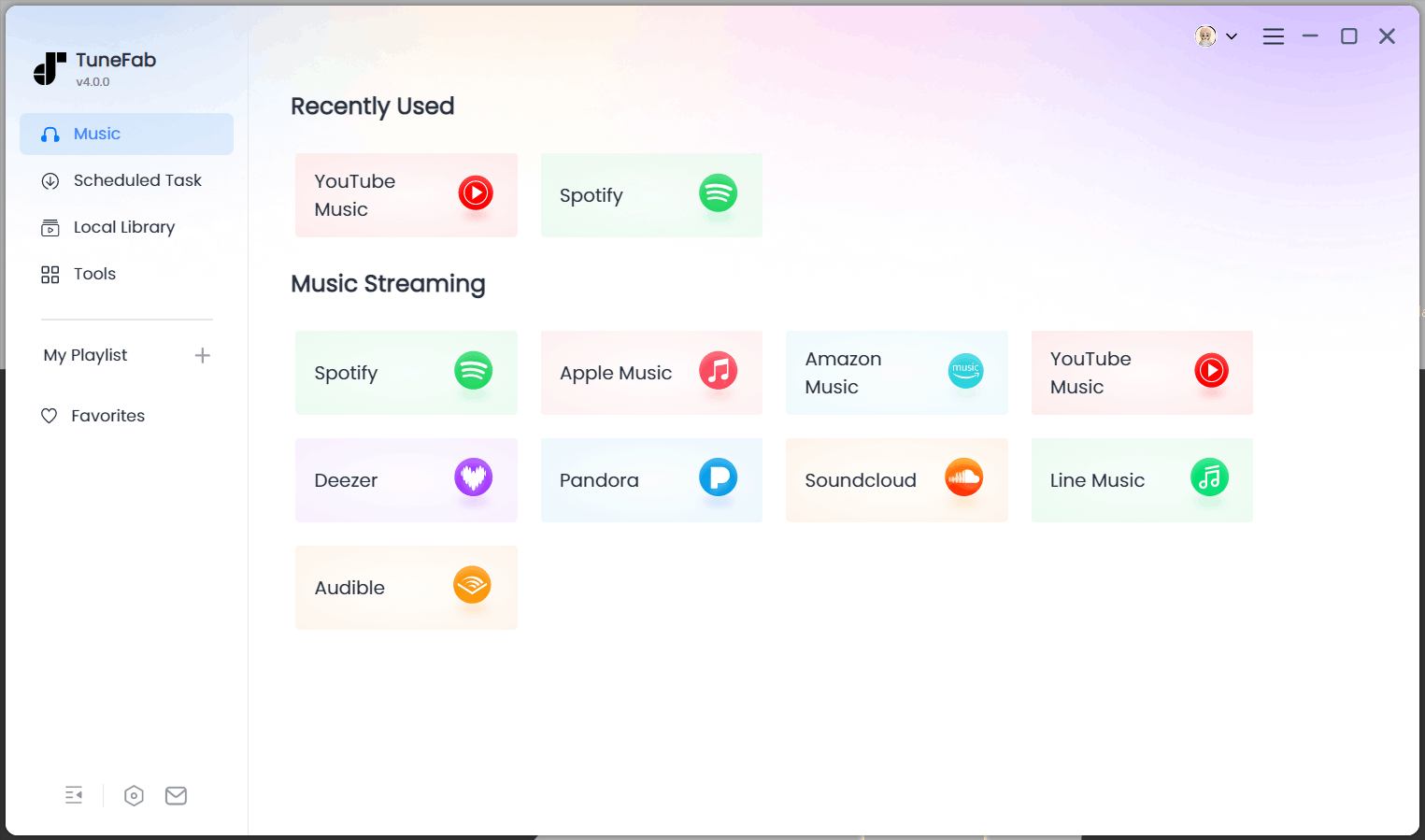
Step 1. Install TuneFab YouTube Music Converter, launch it, and select YouTube Music as your source. You can start ripping right away without signing in, but signing in increases conversion reliability and success rates.
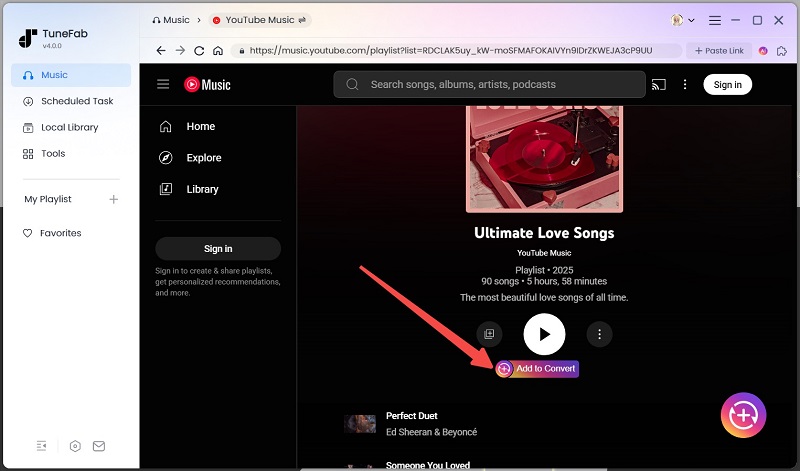
Step 2. Search for the song you want in the built-in YouTube Music web player on TuneFab. Click the "Add" or "Add to Convert" button. The tool will instantly analyze your selection and show a list of tracks on the right.
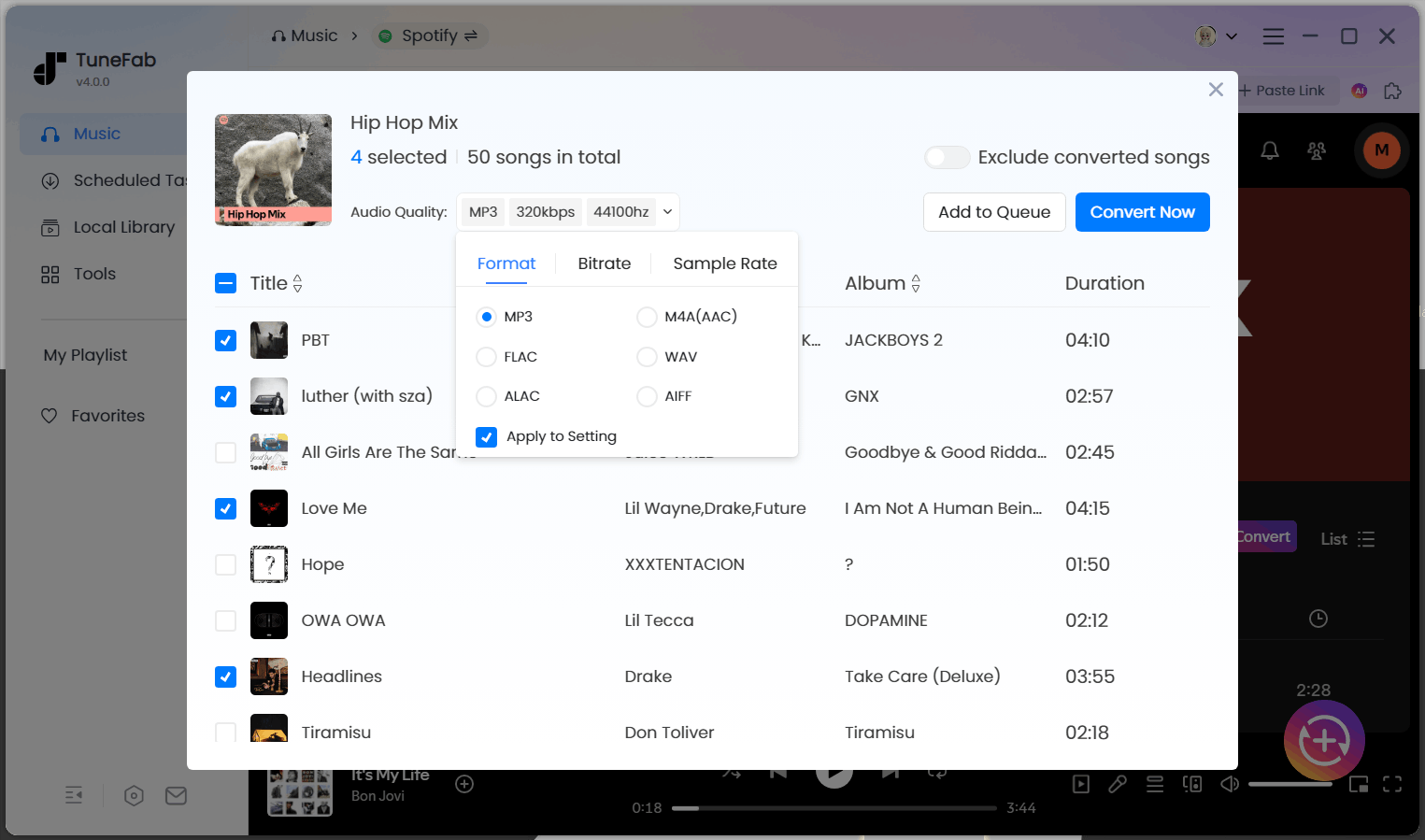
Step 3. On the conversion list, choose the output format, then adjust the bitrate and sample rate as needed.
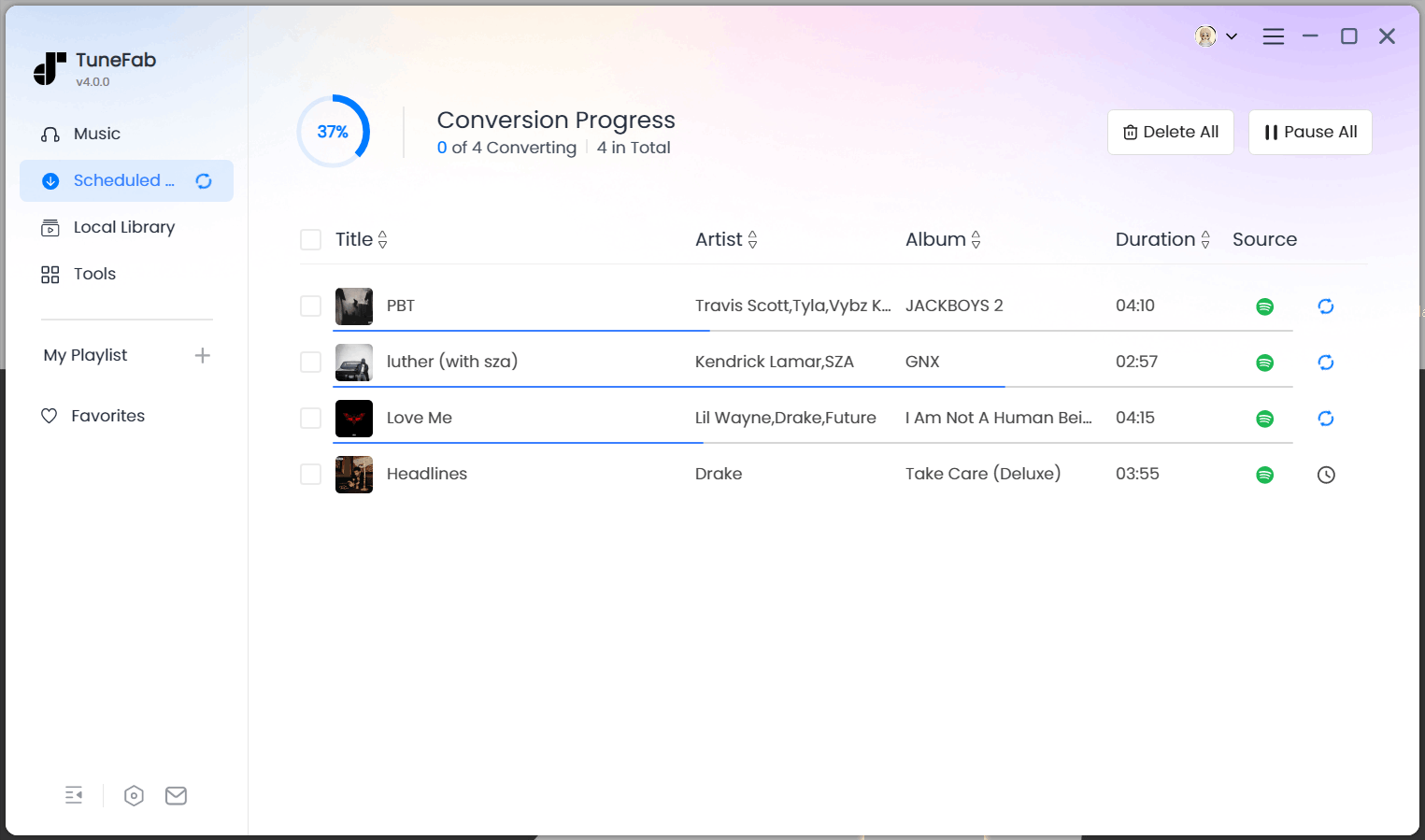
Step 4. Click "Convert Now" to begin ripping instantly. Alternatively, click "Add to Queue" to move your selected tracks to "Scheduled Task," and then hit "Convert All" to proceed. Once the conversion is complete, you can find your ripped audio files in “Local Library”.
Tip: This method, along with the other two methods in this article, captures full songs. If you only want a specific section of a track, consider using an audio recording method instead.
Pros
- Focuses on the YouTube Music library rather than direct audio extraction from ordinary YouTube video URLs.
- Lets you search for and rip individual tracks, albums, and playlists through a built-in YouTube Music web player.
- Supports MP3, M4A, FLAC, WAV, AIFF, and other formats, with adjustable bitrate and sample rate. For MP3 or M4A output, a 256 kbps bitrate can provide high-quality audio while keeping the file size manageable.
- Supports batch conversion and preserves ID3 tags for easier music library management.
Cons
- Requires desktop installation
- Extraction may be affected by source availability or service changes.
Method 2. Rip Songs from YouTube via TuneFab Tool Online
Being on this page, you would have noticed the web-based tool at the top. Essentially, this browser-based YouTube Music ripper rips music from YouTube Music links directly, without the need to download or install software.
Compatible with computer and phone/tablet browsers, this online tool is developed by TuneFab, a trusted brand with 9 years of experience in digital media ripping. You can rip individual songs right from the interface. If you want to rip an entire playlist or album, you’ll need to log in to the TuneFab member center. Don’t worry - it’s 100% safe and secure.
The MP3s that you rip will keep their original ID3 tags. Before starting, you can choose to rip in either 128kbps or 320kbps quality. If you go for songs from a playlist/album, all tracks will be packed in a batch and zipped into a single ZIP file.
Step 1. Copy the link of the song you want to rip.
Step 2. Paste the link to the blank bar on the online tool on the top of the article, then hit "Download".
Step 3. Wait for a while and the download link will be displayed. Hit "Download MP3".

Pros
- Processes supported YouTube Music links in a browser without requiring desktop software installation.
- Offers 128 kbps and 320 kbps MP3 options. The 320 kbps setting provides a high-bitrate MP3 output for better audio quality when the source supports it.
- Supports ID3 tags and lets users process playlists and albums through the TuneFab member center, with tracks packaged into a ZIP file.
Cons
- Outputs MP3 only, offering fewer format options than the desktop converter.
- Requires you to create a TuneFab account and sign in.
Method 3. Extract Audio from YouTube via GitHub youtube-dl
yt-dlp is an actively maintained command-line tool supporting thousands of sites, YouTube included. It started as a fork of youtube-dl, which is no longer actively developed. It handles both single videos and full playlists. For audio, it exports AAC, ALAC, FLAC, M4A, MP3, OPUS, Vorbis, or WAV, and preserves metadata such as ID3 tags.
The project ships stable, nightly, and master channels, and recommends nightly for regular users since stable builds can go stale and break when YouTube changes. Audio extraction relies on ffmpeg and ffprobe; you need the ffmpeg binary, not the Python package of the same name.
The quality depends on the source and the audio quality you can listen to, according to your account. Despite being a terminal application, yt-dlp is simple enough for a beginner to use. But if you're not comfortable with computers, a YouTube music downloader with an easy UI may be a better option.
Step 1. Install yt-dlp
- Windows users: Download "yt-dlp.exe", the standalone 64-bit build for Windows 8+, from the official release page. No Python needed. Place the .exe file in a folder in your system's PATH, or in the folder you'll run commands from.
- macOS users: Download "yt-dlp_macos", the universal standalone build for macOS 10.15+. Or install via pip: python -m pip install -U yt-dlp
- Linux/BSD users: Download "yt-dlp", the platform-independent zipimport binary (requires Python). Or install via pip: python -m pip install -U yt-dlp
Step 2. yt-dlp uses ffmpeg and ffprobe to merge streams and run post-processing like audio extraction. You need the ffmpeg binary, not the Python package of the same name.
- macOS: brew install ffmpeg
- Windows: Download from yt-dlp/FFmpeg-Builds or ffmpeg.org, extract, and add the bin folder to PATH.
- Linux: Install via your package manager, e.g. sudo apt install ffmpeg.
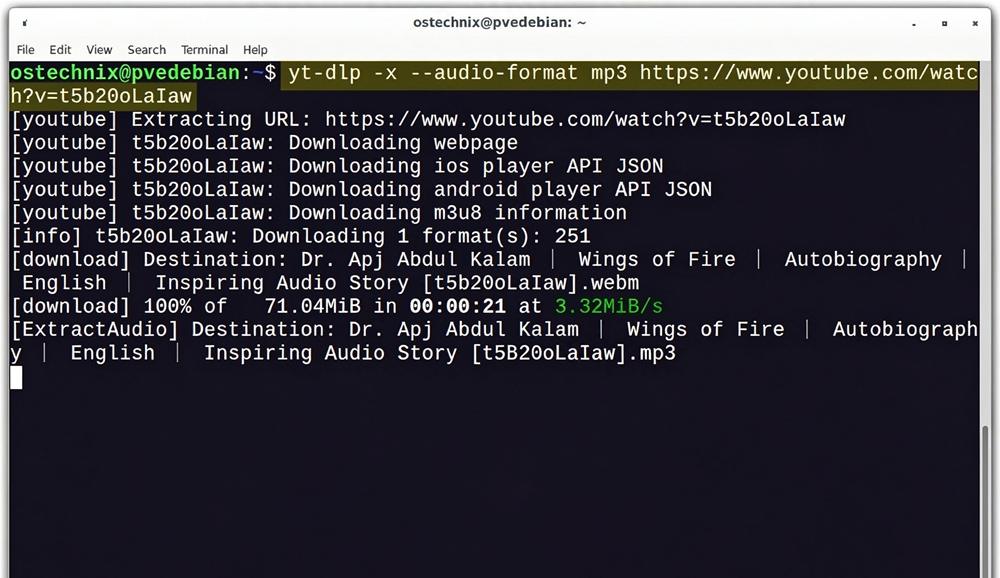
Step 3. Once yt-dlp and ffmpeg are ready, open your terminal or command prompt and enter: yt-dlp -x --audio-format mp3 --audio-quality 0 "YouTube URL"
This rips the video, extracts the audio, and converts it to a high-quality MP3. Swap mp3 for aac, alac, flac, m4a, opus, vorbis, or wav as needed. --audio-quality takes 0 (best) to 10 (worst) for VBR, or a fixed rate like 128K; the default is 5.
To set the output filename: yt-dlp -x --audio-format mp3 --audio-quality 0 -o "%(title)s.%(ext)s" "YouTube URL"
Tip: If YouTube extraction fails, update to nightly before reporting a bug: yt-dlp --update-to nightly. To update a release binary: yt-dlp -U. To list formats: yt-dlp -F "YouTube URL".
Pros
- Extracts audio from ordinary YouTube videos and supports playlist processing.
- Supports MP3, AAC, ALAC, FLAC, M4A, OPUS, Vorbis, and WAV through its audio conversion options.
- Works with FFmpeg to configure output formats and encoding quality.
Cons
- Requires command-line operations and setup of both yt-dlp and FFmpeg.
- Re-encoding audio to a higher bitrate or a lossless format cannot restore details missing from the original source.
Comparison: Which Method Suits You to Rip Music from YouTube?
The 3 methods can all help you rip music from YouTube. However, you will find that each of them offers different features and operational processes, so their targeted needs may not exactly match yours. Here is a detailed comparison table for you to choose the one that best fits your current needs.
| Feature | TuneFab YouTube Music Converter | TuneFab Online Tool | yt-dlp |
| Audio source | YouTube Music tracks, albums, and playlists | YouTube Music links | Ordinary YouTube videos and playlists |
| How it works | Desktop software with a built-in YouTube Music web player | Browser-based extraction | Command-line audio extraction |
| Batch processing | Yes, including playlists and albums | Available for playlists and albums through the member center | Yes, including playlists |
| Output formats | MP3, M4A, FLAC, WAV, AIFF, and more | MP3 | MP3, AAC, ALAC, FLAC, M4A, OPUS, Vorbis, and WAV |
| Audio quality control | Adjustable bitrate and sample rate | 128 kbps or 320 kbps MP3 options | Configurable extraction and re-encoding options |
| Metadata | Supports ID3 tags | Supports ID3 tags | Supports metadata embedding |
| Setup requirements | Install desktop software | No software installation required | Install yt-dlp and FFmpeg |
| Ease of use | GUI; suitable for batch conversion | Simple browser workflow | Requires command-line input |
| Main Limitation | Requires desktop installation; quality depends on source | Limited output formats; playlist/album processing requires member-center login | Requires setup and maintenance of yt-dlp and FFmpeg |
Each method has its own strengths, depending on the audio source and how you want to process it. Use the guide below to choose the most suitable option for your needs.
| Your Needs | Recommended Method | Why |
| Rip individual songs, albums, or playlists from YouTube Music | TuneFab YouTube Music Converter | Supports batch conversion, multiple output formats, and adjustable audio settings. |
| Rip individual YouTube Music tracks without installing software | TuneFab Online Tool | Works in a browser and offers MP3 output at 128 kbps or 320 kbps. |
| Extract audio from ordinary YouTube videos | yt-dlp | Supports direct audio extraction from YouTube videos and playlists, with multiple output formats. |
| Customize audio extraction and encoding settings | yt-dlp | Provides command-line options for selecting formats and configuring audio conversion. |
| Process playlists without manually handling each track | TuneFab YouTube Music Converter or yt-dlp | Both support batch processing; the appropriate choice depends on whether the source is YouTube Music or ordinary YouTube videos. |
FAQs About Ripping Music from YouTube
Is It Legal to Rip Songs from YouTube?
YouTube's Terms of Service restrict downloading, reproducing, or otherwise using content unless the service expressly authorizes the activity, the necessary permission has been obtained, or applicable law permits it. The terms also restrict circumventing features that limit copying or use.
Personal use does not automatically establish that an extraction is permitted. The answer depends on the content, the permissions involved, the applicable law, and the relevant service terms. See the YouTube Terms of Service for the official conditions.
What Audio Quality Can You Get from YouTube?
The available audio quality depends on the source video and the audio streams provided for it. YouTube Music's official audio-quality settings list upper bitrate limits of 48 kbps for Low, 128 kbps for Normal, and 256 kbps for High and Always high, using AAC or Opus. These settings apply to the YouTube Music app; they are not universal bitrate limits for ordinary YouTube videos.
When extracting audio from a regular YouTube video, the selected stream determines the source encoding. Converting it to a higher bitrate does not restore detail lost during earlier compression.
Does Ripping and Converting YouTube Audio to FLAC or WAV Make It Lossless?
No. WAV can store uncompressed audio, while FLAC uses lossless compression. However, converting a lossy source stream to FLAC or WAV does not restore the information discarded during the original encoding. A lossless output format does not prove that the source audio itself is lossless.
Can Music Be Ripped on YouTube Directly?
YouTube's standard video player does not generally provide a feature for exporting a video's audio as a standalone MP3 file. YouTube's offline playback features are intended for playback within supported YouTube experiences and do not ordinarily provide an audio file that can be opened in other apps.
Can I Extract Audio from YouTube Video on iPhone?
Certainly. Given that iOS devices don't have a dedicated YouTube ripper, you would first need to explore the 2 online tools introduced in this article, which are able to rip music directly on your iPhone.
Conclusion
The right way to rip music from YouTube depends on your audio source and preferred workflow. For YouTube Music tracks, TuneFab YouTube Music Converter offers batch ripping, multiple output formats, and adjustable audio settings, while the TuneFab online tool provides a convenient browser-based option. If you want to extract audio from ordinary YouTube videos, yt-dlp offers flexible format and conversion options. Choose the method that best fits your needs, and remember that the final audio quality depends on the original source and any re-encoding.
100% Secure
100% Secure

