


Converting sheet music into MIDI has become an essential workflow in modern music production. By turning traditional notation into a flexible digital format, Convert Sheet Music to MIDI enables musicians to work directly inside any DAW (Digital Audio Workstation), where notes, timing, and instruments can be freely edited and arranged. This makes MIDI a core foundation for composition, arrangement, and sound design.
However, manually inputting notes into a DAW is often slow and inefficient, especially for complex pieces. What once took hours of tedious transcription can now be completed in seconds thanks to AI-powered and Online tools, which are rapidly reshaping how musicians digitize and work with sheet music.
- Way 1. Convert Sheet Music to MIDI Online with Melogen AI (Top Pick)
- Way 2. Scan & Edit Music Sheets via Desktop Software (Professional Solution)
- What If You Can't Find the Sheet Music? (The Pro Secret)
- Comparison: Online AI Tools vs. Desktop Sheet Music Converters
- Troubleshooting: How to Improve MIDI Conversion Accuracy?
- FAQs about Converting Sheet Music to MIDI
Way 1. Convert Sheet Music to MIDI Online with Melogen AI (Top Pick)
If you’re looking for a fast and accurate way to convert sheet music to MIDI free online, Melogen AI stands out as a top choice. Powered by advanced AI-driven OCR (Optical Character Recognition), it can intelligently read musical notation from PDFs and images, then convert them into fully editable MIDI files within seconds.
Unlike traditional sheet music to audio converter tools that struggle with complex notation, Melogen AI is trained on millions of sheet music samples. This allows it to recognize notes, rhythms, key signatures, and musical symbols with impressive precision, even from scanned PDFs or photographed scores. With over 50,000 active users and more than 1 million files converted across 180+ countries, it’s a reliable solution for modern music workflows.wq
Key Features at a Glance
- Advanced AI OCR recognition – Accurately reads printed and scanned sheet music with high precision
- Fast, automated processing – Converts files into MIDI within seconds, fully hands-free
- Strong PDF support – Works seamlessly with PDF, JPG, and PNG formats
- No installation required – 100% browser-based, no plugins or setup needed
- Multiple export formats – Download as MIDI or MusicXML for DAWs and notation software
- Secure and private – Files are encrypted and automatically deleted after processing
One of the biggest advantages of Melogen AI is its simplicity and instant processing. You can complete the entire conversion in just a few clicks:
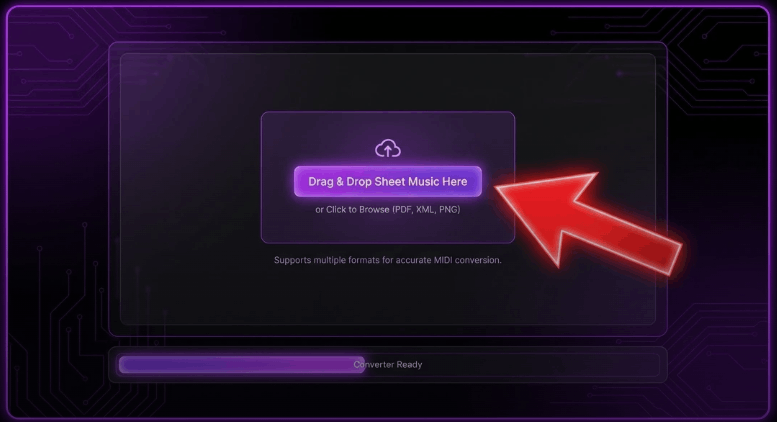
Step 1. Upload your sheet music
Import a PDF, JPG, or PNG file directly into the platform. After upload, the system automatically reads and analyzes the sheet music using OCR technology.
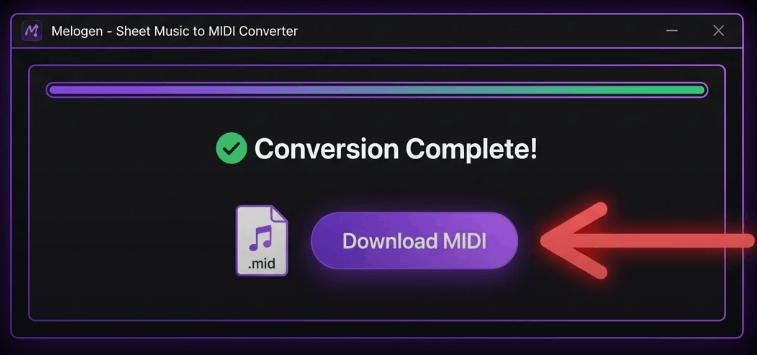
Step 2. Download your MIDI file
Export the result instantly in standard MIDI format (or MusicXML if needed).
Way 2. Scan & Edit Music Sheets via Desktop Software (Professional Solution)
Using desktop software to scan sheet music provides a more precise and professional workflow, especially for users who need full control over the final MIDI output. Tools like ScanScore allow you to import PDFs or scan printed scores, then convert them into MIDI with a much higher level of accuracy than fully automated solutions.
One of the main reasons to choose desktop software is its powerful correction and batch scanning capabilities. After the initial AI recognition, you can manually review and fix notes, rhythms, and symbols, ensuring the final result is clean and usable. At the same time, batch processing makes it efficient to digitize large volumes of sheet music, which is particularly valuable when working with complex orchestral scores or extensive printed collections.
Note: This approach is best suited for professionals such as composers, arrangers, or institutions handling detailed scores. It typically comes with a higher cost and a steeper learning curve, but the improved accuracy and editing flexibility make it worthwhile for advanced use cases.
Step 1. Import or scan your sheet music
Upload PDF files or scan printed scores using a scanner or mobile device.
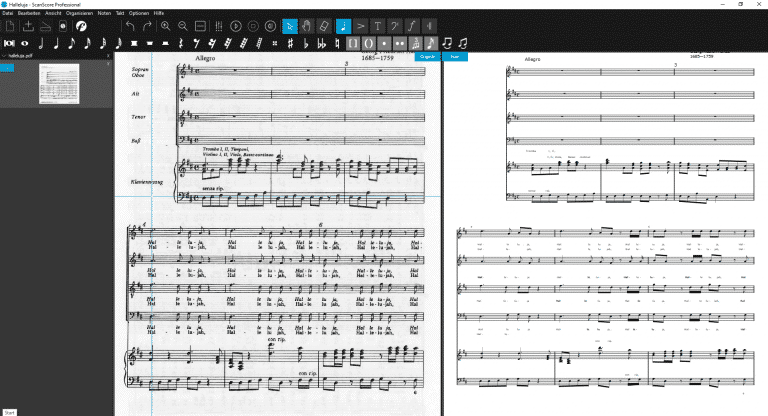
Step 2. Review and correct the notation
Fine-tune notes, timing, and musical symbols with built-in editing tools.
Step 3. Export as MIDI
Save the finalized score as a MIDI or MusicXML file for further use.
What If You Can't Find the Sheet Music? (The Pro Secret)
Not every song comes with available notation. Many classic pieces, niche tracks, or newly released pop songs simply don’t have purchasable sheet music, making traditional music transcription workflows slow and frustrating. Instead of searching endlessly, a more efficient approach is to work directly from high-quality audio.
This is where TuneFab All-in-One Music Converter becomes essential. It allows you to extract high-quality 320kbps MP3/FLAC audio from platforms like Spotify and Apple Music, an important factor for AI-based transcription. The clearer the audio source, the more accurately tools like Melogen AI can detect pitch, rhythm, and instrumental details when converting audio to MIDI.
Note: This method is often faster and more direct than searching for sheet music first. It also captures the original performance more naturally, preserving timing, groove, and expressive details that may be lost in traditional notation.
Rather than converting sheet music to MIDI, this method skips the middle step entirely:
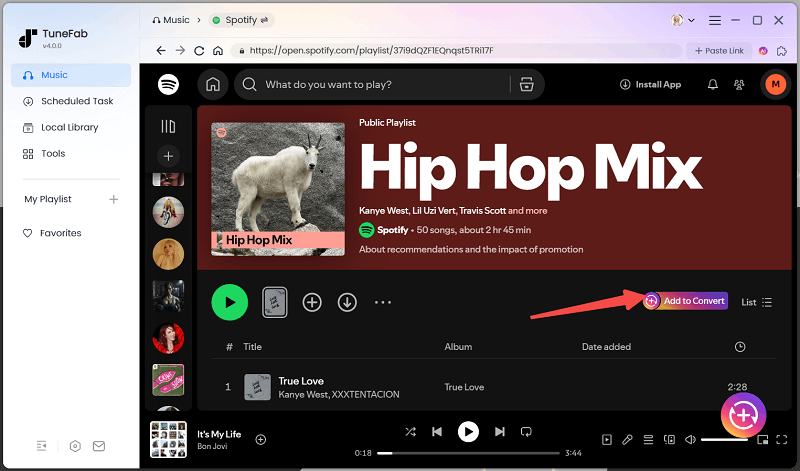
Step 1. Get high-quality audio with TuneFab All-in-One
Download and convert songs from Spotify or Apple Music into 320kbps MP3 files.
Step 2. Convert audio to MIDI with Melogen AI
Upload the MP3 into Melogen AI’s Audio to MIDI tool for automatic transcription.
Comparison: Online AI Tools vs. Desktop Sheet Music Converters
When choosing between different AI Tools and Sheet Music Converters, the main difference comes down to speed and convenience versus control and advanced editing. Online tools are designed for quick, instant conversion, while desktop software focuses more on detailed correction and large-scale processing.
Here’s a simple comparison to help you decide:
| Feature | Online AI Tools | Desktop Sheet Music Converters |
| Accuracy | High for clean PDFs and printed scores | Higher for complex scores with manual correction |
| Batch Processing | Yes | Yes |
| Price | Often free or low-cost | Usually paid software |
| Best For | Quick conversion, students, independent musicians | Professionals handling complex or large projects |
In most cases, online AI tools are the better starting point because they are faster, easier to use, and require no setup, while desktop converters are more suitable for advanced, professional workflows.
Troubleshooting: How to Improve MIDI Conversion Accuracy?
When working with MIDI Conversion Accuracy, most issues come from input quality rather than the conversion tool itself. Improving your source files is the fastest way to get cleaner and more reliable MIDI results. Here are the common issues and how to fix them:
| Problem Source | What goes wrong | How to improve accuracy |
| Blurry PDF / image sheet music | Missing or misread notes, incorrect rhythms | Use high-resolution scans, avoid tilted or faded pages, ensure clear contrast |
| Low-quality audio (for transcription) | Wrong pitch detection, missing instruments | Use high-fidelity audio (e.g., 320kbps MP3 or lossless files) |
| Crowded or complex scores | Overlapping symbols confuse OCR | Crop pages properly and process one system/page at a time |
| Compressed audio files | Distorted rhythm and timing | Avoid low-bitrate or heavily compressed sources |
Practical tips from real usage
- Clean, high-resolution sheet music consistently improves OCR accuracy
- 320kbps audio significantly improves AI Music Transcription results
- Straightening and cropping images before upload reduces recognition errors
- Simpler inputs always produce more stable MIDI output
In real workflows, the biggest improvement in MIDI Conversion Accuracy usually comes from upgrading input quality, not changing tools
FAQs about Converting Sheet Music to MIDI
Can I convert PDF to MIDI for free?
Yes. Many sheet music to MIDI online tools, including AI-based platforms like Melogen AI, offer free conversion options with limited usage. Free plans are usually enough for casual users, while advanced features or higher conversion limits may require a paid upgrade.
How accurate is AI sheet music recognition?
Modern AI Tools achieve high accuracy on clear, well-scanned sheet music. Standard notation (notes, rhythms, key signatures) is usually recognized very reliably. However, heavily compressed images, handwritten scores, or very complex orchestral arrangements may require small manual adjustments after conversion.
Is MIDI the same as an MP3?
No. MIDI is not audio. It is a data file that contains musical instructions like notes, timing, and instrument information. MP3 is a recorded audio file. MIDI can be edited and changed, while MP3 is fixed playback audio.
Can I open a MIDI file?
Yes. MIDI files can be opened in most DAWs and music software, such as FL Studio, Ableton Live, Logic Pro, or free tools like MuseScore. You can also assign different instruments and edit notes directly.
What is the difference between sheet music and MIDI file?
Sheet music is a visual representation of music notation for reading and performance. A MIDI file is a digital representation of the same music that can be edited, played back, and used in production software. In short, sheet music is for reading, while MIDI is for editing and production.
Conclusion
Converting sheet music into MIDI is now much faster and more flexible thanks to modern AI Tools and Sheet Music Converters like Melogen AI and ScanScore. Whether you are working from PDFs, images, or even audio sources, these solutions make it easy to generate editable MIDI files that can be used directly in any DAW for composition, arrangement, or production.
For situations where sheet music is not available at all, tools like TuneFab All-in-One Music Converter provide an additional advantage by extracting high-quality audio sources for Music Transcription workflows. Combined with AI transcription tools, this creates a more flexible and complete workflow for turning real-world music into editable MIDI.

