


As a subscriber of Amazon Prime Music, you may want to make the most of over 100 million songs. In this case, you can see music files posting questions like "Can you burn Amazon Prime Music to CD?" or "Can I burn a CD from Amazon Prime Music?" on Quora and Reddit.
What's the answer? Let's find out here.
Before you start, there is an important distinction: Amazon Music files are not all available for CD burning.
- Music you purchase from Amazon Music can be downloaded as local files and then added to a CD-burning workflow. Likewise, ordinary local audio files already stored on your computer can be burned directly.
- However, offline downloads made through the Amazon Music app are intended for playback within the app and are not ordinary audio files that you can simply drag into Windows Media Player or Apple Music for burning. You can still use a music converter to convert Amazon Music streaming tracks into audio formats suitable for CD burning.
1. Tools You Need Before Burning CD with Amazon Music
Before burning Amazon Music to a CD, prepare the following items. The key requirement is that the music must be available as compatible local audio files. Amazon Music app downloads for offline playback cannot be directly used by CD-burning software.
1. Compatible local Amazon Music files - Purchased Amazon Music MP3 downloads or use a Lossless Amazon Music Downloader to get Amazon Music as WAV/FLAC/MP3 files.
2. CD Burning Software - to burn the Amazon music files from the local folder to a CD. Windows Media Player on Windows and Apple Music on Mac can handle the basic CD-burning process.
3. A CD Burner Drive - to write the data of Amazon music onto CDs
4. A blank CD-R or CD-RW disc - for preserving the burned Amazon music
CD-R vs. CD-RW: Which One Should You Prepare?
- CD-R is generally the safer choice for music CDs because it is widely supported by CD players and car stereos. Once burned, the disc cannot be erased and reused.
- CD-RW can be erased and burned again, which is useful for temporary or test discs. However, some older CD players and car stereos may not support CD-RW.
For the best compatibility, CD-R is usually recommended for a final music CD.
Audio CD vs. Data CD: Which One Should You Choose?
The disc type determines both how much music you can store and which players can read it.
| Disc Type | Typical Capacity | Best For | Compatibility |
| Audio CD | Up to about 80 minutes | Car stereos, standard CD players, home stereos | Broad compatibility with conventional CD players |
| Data CD | About 700 MB | Storing many MP3 files or other supported audio files | Requires the player to support the file format |
- Choose Audio CD when you want the disc to work with a traditional CD player or car stereo. Its capacity is based mainly on playing time, so an 80-minute disc can hold about 80 minutes of audio regardless of whether the source files are MP3, WAV, or FLAC.
- Choose Data CD when your target player supports MP3 or another compatible file format and you want to store more music. The files are stored directly as data, so the disc's roughly 700 MB capacity can hold considerably more music than an Audio CD.
What Audio Format Should You Prepare?
The right audio format depends on how you plan to use the disc:
- For an Audio CD: MP3, WAV, FLAC, and other supported local audio files can be used as source files. The burning software converts them into the standard Audio CD format during the burning process.
- For a Data CD: MP3 is usually the more practical choice because it takes less storage space and is widely supported by devices that can play MP3 CDs.
- For preserving a lossless source: WAV or FLAC is preferable when you want to keep a lossless local copy before burning or for future conversion. However, using a lossless source does not increase the capacity or change the specifications of the final Audio CD.
Read More:
Quick Guide: Which Setup Should You Choose?
In short: choose an Audio CD + CD-R for the widest compatibility, or a Data/MP3 CD + MP3 when you want to fit more songs on one disc and your player supports MP3. WAV or FLAC is better for keeping a lossless local copy, but it won't increase the capacity of an Audio CD.
Windows (Use WMP):
| Your Goal | Audio Format | CD Type | Capacity | Recommended Disc | Why |
| Best compatibility | MP3, WAV, or FLAC | Audio CD | Up to ~80 min | CD-R | Works with most conventional CD players and car stereos. |
| Fit more songs | MP3 | Data CD | Up to ~700 MB | CD-R | Stores MP3 files directly, so it can hold more songs than an Audio CD. |
| Test before final burning | MP3, WAV, or FLAC | Audio CD or Data CD | Depends on disc type | CD-RW | Can be erased and reused, but compatibility varies by player. |
Mac (Use Apple Music App):
| Your Goal | Audio Format | CD Type | Capacity | Recommended Disc | Why |
| Best compatibility | MP3, WAV, or FLAC | Audio CD | Up to ~80 min | CD-R | Works with most conventional CD players and car stereos. |
| Fit more songs | MP3 | MP3 CD | Up to ~700 MB | CD-R | Stores MP3 files directly and can hold more songs if the player supports MP3 CDs. |
| Store audio files | MP3 and other supported files | Data CD | Up to ~700 MB | CD-R | Useful for file storage when the target device supports the file formats. |
| Test before final burning | MP3, WAV, or FLAC | Audio CD or Data CD | Depends on disc type | CD-RW | Can be erased and reused, but compatibility varies by player. |
How to Prepare Amazon Music Files for Burning
The first step is to get the songs you want to burn as local audio files.
Option 1: Purchase Amazon Music as MP3s
Purchased Amazon Music is different from music downloaded for offline listening through the Amazon Music app. Purchased tracks can be downloaded as local files and used with compatible media software. By contrast, subscription downloads stored for offline playback in the Amazon Music app are not ordinary MP3/WAV files that you can freely add to a CD-burning program.
If you already have purchased music local files, you can skip directly to the Windows or Mac burning method below. If you haven't downloaded the music yet, check out this detailed guide to download purchased Amazon Music.
Option 2: Download Amazon Music as WAVs/FLACs/MP3s
Purchased Amazon Music is available as MP3 files, which use lossy compression. If you want to preserve higher-quality audio from supported Amazon Music streaming sources, lossless formats such as FLAC or WAV are more suitable. A dedicated converter like TuneFab Amazon Music Converter can save supported Amazon Music HD and UHD tracks as WAV or FLAC while also supporting MP3 and other output formats.
TuneFab also supports batch conversion, preserves metadata such as song titles, artists, albums, and cover art, and lets you customize output settings such as bitrate, sample rate, and output format. This gives you more flexibility when preparing files for CD burning or other local playback.
Not sure how to download Amazon Music songs? Check out these step-by-step guides for Windows and Mac:
- How to Download Amazon Prime Music to Windows [Full Guide]
- How to Download Amazon Music to MAC (3 Methods)
3. How to Burn Amazon Prime Music to CD in 2 Ways
After you have compatible local Amazon Music files, you can burn them with the built-in media software on Windows or Mac. The steps differ slightly depending on your computer and the type of disc you want to create._
Method 1: Burn CD from Amazon Music Downloads via WMP
For Windows users, Windows Media Player will be an ideal option, as you don't need to install extra software to process the Amazon music-to-CD burning process. Simply follow the guide to get it completed now.
STEP 1. Insert a blank disc into the optical drive that is connected to your Windows PC.
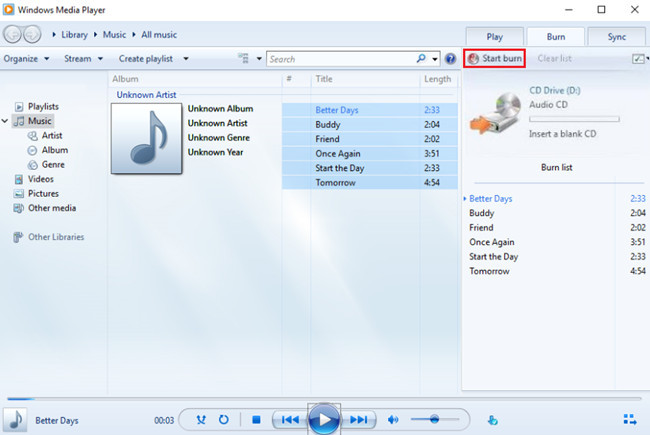
STEP 2. Launch Windows Media Player on PC, then on the right side, select "Burn".
STEP 3. Hit the "Burn options" and select to burn an "Audio CD" or "Data CD or DVD."
STEP 4. Drag the Amazon Music files you want to burn into the burn list on the right side of Windows Media Player. Check the total duration for an Audio CD and make sure the files fit within the disc's capacity.
STEP 5. Simply tap the "Start Burn" icon, and it will start to burn Amazon Prime music to CD.
Note: If Windows Media Player provides a choice of burn speed, a slower or moderate speed can be preferable when compatibility is more important than finishing as quickly as possible. Avoid using the fastest available speed if you are troubleshooting playback or burn errors.
Once the burn finishes, allow the disc-writing process to complete before ejecting the disc. If the software offers a finalization/closing option, complete it so the disc can be read reliably by other devices.
Method 2: Burn Amazon Music to CD with Apple Music
For Mac users, you can directly use Apple Music to manage your library and burn Amazon Prime music to a CD. On current macOS versions, Apple Music can create Audio CDs, MP3 CDs, and Data CDs/DVDs. The burning process is based on a playlist rather than simply selecting files from a folder.
STEP 1. Insert a blank disc into an external drive or Apple SuperDrive while connecting it to your Mac.
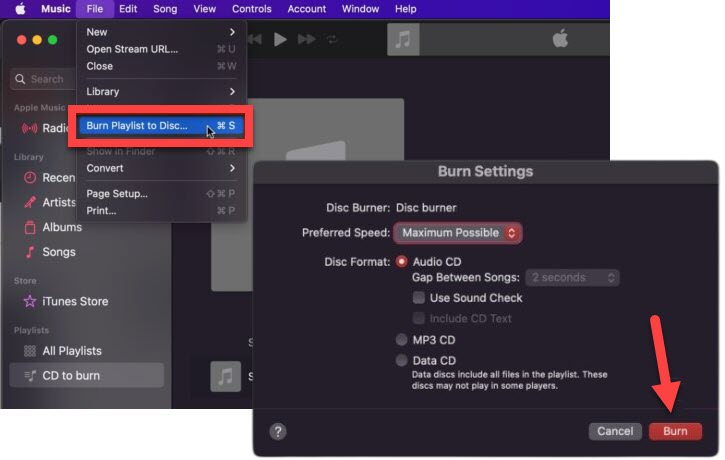
STEP 2. Open Apple Music and navigate to "File" > "New" > "Playlist". If you don't see checkboxes beside songs, go to Music > Settings > General and enable "Songs list checkboxes."
STEP 3. Click "File" and select "Burn Playlist to Disc". Then, the "Burn Settings" window will show up. Choose "Audio CD" when broad compatibility with standard CD players is the priority.
STEP 4. Click the "Burn" button and start to burn the playlist of Amazon songs to CD.
4. FAQs About Burning Amazon Prime Music to CD
Q1: How to import songs from CD to Amazon Music?
In some cases, you may want to import a CD to Amazon Music instead. If so, you can take advantage of the Windows Media Player to rip songs from a CD and then upload music to Amazon Music. You should be aware that this way doesn't work for protected CDs. Now, let's see how it works.
STEP 1. Insert the CD into your Windows PC and run the Windows Media Player.
STEP 2. Click "Rip" > "More Options" > "Rip Music" and choose "MP3".
STEP 3. Then, select "Track" > "Track of Audio" and click the "Rip" button to rip songs from a CD to MP3.
STEP 4. Now, log in to your Amazon Music account on the web or in the app. Then, go to your "Profile" > "Settings" > "Automatically Import Music from".
STEP 5. Now, select to import MP3 files from the library of Windows Media Player, and it's all done.
Q2: What's the maximum number of Amazon Music songs can you store on a CD?
At most, a CD can store up to 99 tracks while each track can keep up to 100 indexes. However, this is an ideal situation.
For an Audio CD, the more useful limit is playing time: a standard disc can hold up to about 80 minutes of music. The number of songs therefore depends on the length of each track.
For a Data CD, the practical limit is about 700 MB, so the number of MP3 songs depends on their individual file sizes. For example, smaller MP3 files allow substantially more tracks than larger high-bitrate files.
Q3: Should I use CD-R or CD-RW?
For a music CD that you want to play in different CD players, CD-R is generally the safer choice. CD-RW can be erased and reused, but some older CD players may not support it.
Q4: How can I tell if a CD was burned successfully?
After the burning process finishes, don’t remove the disc immediately if the burning software is still finalizing it. Once the software reports that the burn is complete, you can verify the disc in a few ways:
1. Check whether the disc can be read. Eject the CD and insert it again. The computer should recognize the disc and display its contents or audio tracks.
2. Test playback. For an Audio CD, play several tracks from the beginning, middle, and end of the disc. Check for skipping, missing tracks, or playback errors.
3. Check the file list for a Data CD. Open the disc in File Explorer or Finder and make sure the expected files are present and can be opened.
4. Test it on the target device. If you burned the CD for a car stereo or standalone CD player, test it there as well. A disc that works on a computer may not necessarily be compatible with every CD player.
If the disc is readable and the tracks or files play normally on the intended device, the burn was generally successful. If playback fails, try burning a new disc at a lower speed and make sure the disc type and format are supported by the target player.
Conclusion
After reading this post, you must have an idea of how to burn Amazon Prime Music to CD.
The key is to start with the right kind of local audio file. Purchased Amazon Music and compatible local files downloaded with TuneFab Amazon Music Converter can enter the CD-burning workflow, while Amazon Music app offline downloads are not ordinary files that can simply be burned to a disc.
For the broadest compatibility with traditional CD players and car stereos, choose an Audio CD and keep the playlist within roughly 80 minutes. If your playback device supports MP3 and you want to store more music, a Data CD with about 700 MB of capacity is the more practical option.
Once your files are ready, Windows users can use Windows Media Player, while Mac users can use Apple Music to create the disc. Choose a suitable CD-R or CD-RW, avoid unnecessarily high burn speeds, let the disc finish writing, and test it on the intended player before relying on it.

