


Listening to Amazon Music online is straightforward, but using your music on an MP3 player, car stereo, or DJ software can be more complicated, even with an active Amazon Music Prime or Unlimited subscription. Converting favorite songs into local files is a popular solution for users. But can you rip music from Amazon Music? We have outlined several currently available methods below. Choose the one that best fits your needs, or jump directly to the method you are interested in.
Quick Decision:
- Direct Conversion: Best for batch processing, with support for multiple output formats and ID3 metadata.
- Real-Time Recording: Suitable for capturing a small number of tracks. It is flexible but restricted to real-time recording.
- Official Purchase & Download: The official way to obtain DRM-free audio files that you can download and keep locally.
What Does "Ripping" Amazon Music Mean?
"Ripping audio" traditionally refers to extracting digital audio streams from optical media like CDs. In the context of Amazon Music, ripping generally means creating a local audio copy of music that can be stored and played outside the Amazon Music app.
This is different from using the Amazon Music app's built-in "Download" feature. The key difference is whether you get an app-managed download or a standalone audio file.
- Official App Downloads (Encrypted Cache): When you tap "Download" inside the Amazon Music app, the platform stores encrypted app data on your device for offline playback. These downloads are tied to the authorized Amazon app and your account subscription status.
*If you need more information about how these restrictions work, see our guide to Amazon Music DRM and its limitations.
- Extracted Local Files (Standalone Audio): Ripped Amazon Music songs/albums/playlists are standard audio files stored directly on your local drive. They can be played on any standard media player, burned to CDs, and used outside the Amazon Music app.
Compare the Ways to Rip Amazon Music
When you search for "how to rip songs from Amazon Music", search engines will bring up thousands of results in seconds. To save you time, we have handpicked 3 practical methods.
Before going through each option, compare their main differences in speed, output, batch processing, and limitations.
| Metric | Direct Conversion (e.g., TuneFab) | Real-Time Audio Recording (e.g., Audacity) | Official Purchase & Download |
| Best for | Users who frequently process albums and playlists | Users who prefer occasional manual recording for specific snippets/clips | Users who have purchased songs and albums from the Amazon Digital Music Store |
| Processing Speed | Fast, up to 35X claimed by the software | 1:1 real-time playback | Based on network conditions |
| Batch Processing | Yes, supported | No | No |
| Output Quality | Up to 320 kbps MP3; FLAC/WAV output available (vendor spec) | Depends on audio drivers and recording settings (usually lower than the original) | Average 256kbps MP3 |
| ID3 Tags & Cover Art | Preserved automatically | Requires manual editing | Preserved automatically |
| Potential Risks & Limitations | May violate Amazon's Terms of Use; requires a subscription after the trial | May violate Amazon's Terms of Use; It is Time-consuming | Requires a separate purchase for singles/albums and can be quite costly |
Important Note:
Ripping streaming content may conflict with Amazon's Terms of Use and applicable copyright laws in some regions (for example, under the U.S. DMCA). Please check the rules that apply where you live beforehand. Purchasing downloads is the only fully compliant option. Whatever method you choose, keep the files for personal listening only and do not distribute or use them commercially.
How to Rip Music from Amazon Music Unlimited/Prime
To rip music from Amazon Music Unlimited or Prime, you either convert the music with a dedicated tool or record it as it plays. Below, we will show you how both methods work.
Method 1. Direct Conversion Using TuneFab Amazon Music Converter
Today, many desktop Amazon Music rippers can access Amazon Music through a built-in web player and convert selected songs, albums, or playlists into common audio formats. This is useful if you need to process multiple songs or playlists rather than just one or two tracks.
For instance, TuneFab Amazon Music Converter is one such tool. With its integrated web player, it can rip songs, albums, playlists, and podcasts from Amazon Music into several common audio formats for more flexible offline playback.
What Can You Get from TuneFab Amazon Music Converter:
● Supports Amazon Music Unlimited, Prime, and Free accounts.
● Saves Amazon Music tracks in MP3, FLAC, WAV, AIFF, M4A, ALAC, and AAC.
● Supports up to 35X conversion speeds for faster batch processing.
● Preserves high-quality audio, complete ID3 metadata, and lyrics.
● Allows customization of audio parameters such as sample rate and bitrate before conversion.
● No ads or bundled software detected during our testing.
Steps on how to rip Amazon Music via TuneFab Amazon Music Converter:
Step 1. Install the program on Windows or Mac, open it, and sign in to your Amazon account in the built-in web player.
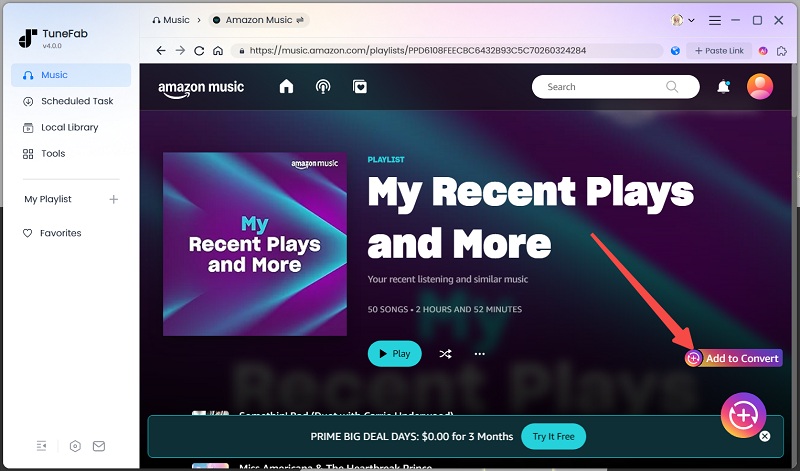
Step 2. Browse your personal library or search for target tracks/albums. Then, click on the "+" icon or the "Add to Convert" button to add tracks to the conversion queue.
Step 3. To customize audio preferences, navigate to the Converting tab, and then click "Settings" to adjust output format and quality, such as bitrate and sample rate. Then hit "Convert Now" to start ripping. 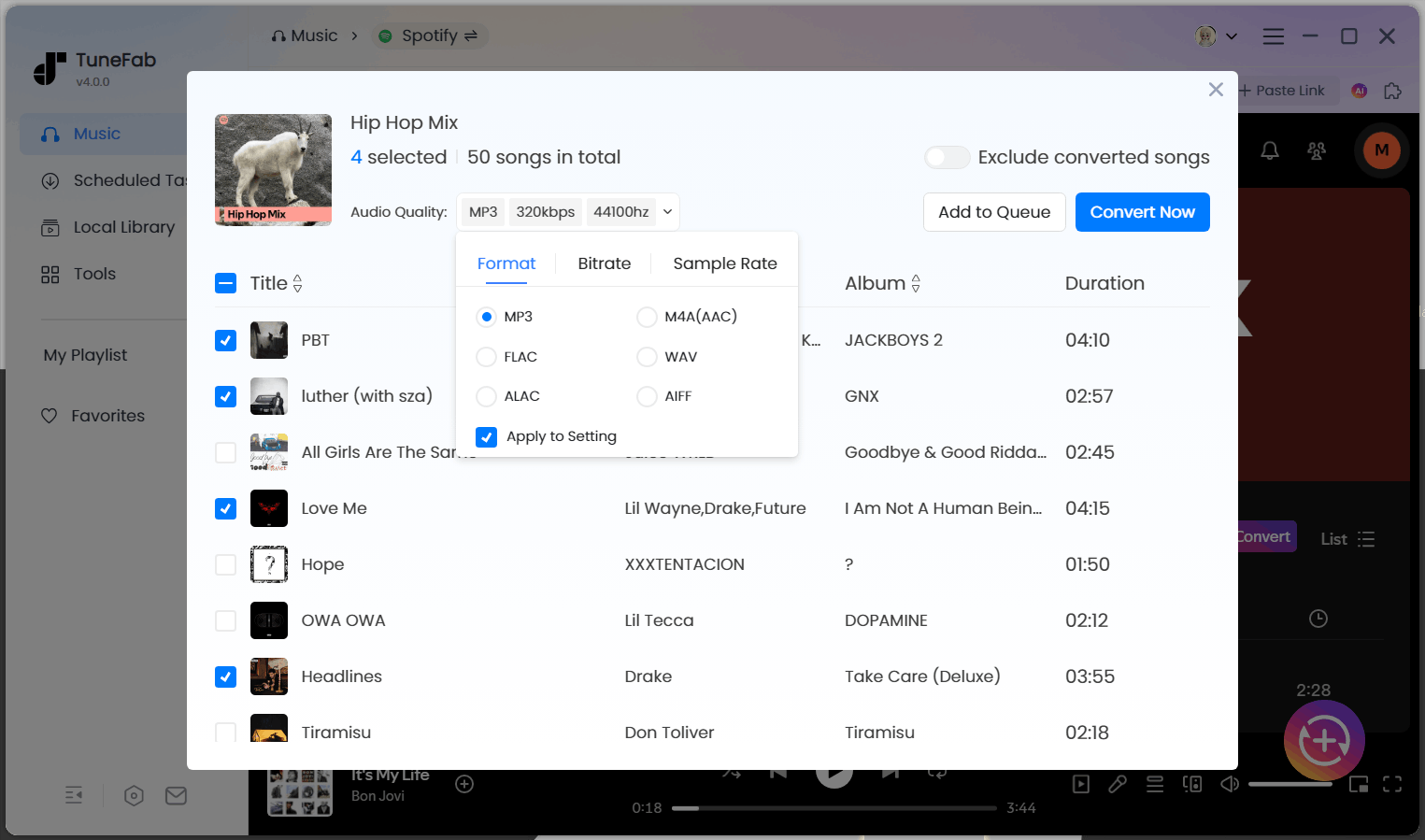
Method 2. Real-time Audio Recording via Audacity
Another third-party method for making a local copy of Amazon Music Unlimited/Prime is to use an audio recorder while the song is playing. Unlike direct conversion, this method captures audio from the system playback path in real time to generate local audio files. It can be used with Amazon Music tracks that can be played through your computer's audio output.
Here, we use the free, open-source audio recorder Audacity as an example to rip music from Amazon Music for free.
Step 1. Download and launch Audacity on Windows or Mac.
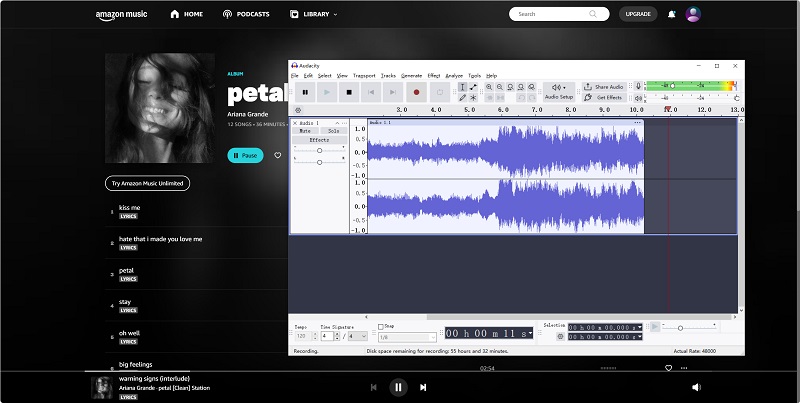
Step 2. Set up audio recording in "Audio Setup".
- For Windows: Set the audio host to Windows WASAPI and choose the recording device for your current system playback output.
- For Mac: Use a virtual audio device such as BlackHole or Soundflower for both output and Audacity input.
Step 3. Navigate to the song on Amazon Music. Click the red Record button in Audacity, then play the song.
Step 4. Once the track finishes, stop the recording, trim unwanted silences at the beginning and end, and go to "File" > "Export Audio..." to choose desired audio format and configuration.
Tips. Looking for a detailed guide? Check: How to Record Amazon Prime Music
How to Rip Purchased Amazon Music Songs/Albums
If you have purchased music from Amazon rather than accessing it through a Prime or Unlimited subscription, the situation is different.
Amazon provides download options for eligible purchased digital music. Strictly speaking, this is not "ripping from Amazon Music", but it is an official alternative for you to obtain purchased Amazon Music as downloadable MP3 files. Here is how to download them on iPhone or Android.
Step 1. Open the Amazon Music app and sign in with the Amazon account used to make the purchase.
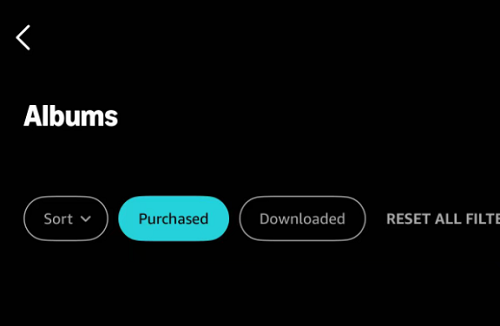
Step 2. Go to "Library", filter the view to "Purchased", and find the song or album you want to download.
Step 3. Tap on the three-dot icon next to the song or album and choose "Download".
Tips: For instructions on downloading purchased music on a PC/Mac or through the web player, please explore the Full Guide to Download Music from Amazon Music.
FAQs About Ripping Amazon Music
Is it legal to rip Amazon Music?
When it comes to the legal side, there is no single yes or no answer. It comes down to where you live and how you plan to use the files. Converting or recording streaming content may also be subject to Amazon’s Terms of Use and rules concerning copyright and DRM circumvention.
Before using any third-party tool, check the terms that apply to your Amazon Music subscription and the laws in your country or region. Use downloaded or recorded files only in ways permitted by applicable laws and service terms, and do not distribute or use them commercially unless you have the necessary rights.
What is the best quality to rip Amazon Music?
FLAC and MP3 are two practical choices, but they serve different needs. FLAC is suitable if you prioritize audio fidelity and have enough storage space, while MP3 is a more convenient choice when you need smaller files and broader device compatibility.
- If you want to keep the output in a lossless format, see our guide on How to Convert Amazon Music to FLAC. Keep in mind that converting a lossy source to FLAC does not restore audio information that was already lost.
- For better compatibility with MP3 players, car stereos, and other devices, MP3 is often the more convenient option. See our guide on How to Convert Amazon Music to MP3 for the detailed steps.
Is there any free way or online tool to rip Amazon Music?
Yes, we also found some tools during testing that claim to rip Amazon Music for free without installing desktop software. However, their reliability can vary, especially when processing album or playlist links.
In our testing, the online tool sometimes required the same link to be submitted at least three times before it could be parsed successfully. We also found cases where an album URL was recognized as only a single track instead of the full album. During peak usage periods, downloads could also fail with an error message such as {"error":"too many concurrent downloads"}.

As a result, online tools may be convenient for occasional use, but they can be less reliable for albums, playlists, or larger download tasks.
Will ripping music from Amazon Music keep the original ID3 tags and cover art?
Based on our testing results, official purchases and using desktop software like TuneFab Amazon Music Converter automatically extracted and preserved ID3 tags, including song title, artist, album name, genre, track number, and album artwork. On the other hand, audio recording tools like Audacity did not capture metadata, so you have to manually enter track titles and artist names in Audacity's tag editor before exporting.
Can I rip an entire Amazon Music playlist at once?
Yes, but only with professional Amazon Music downloaders. They usually support batch conversion, allowing you to process multiple tracks and convert them in one go.
Final Words
Ripping Amazon Music can be done in several ways, but the most suitable option depends on what you need.
If direct conversion fits your batch processing workflow, TuneFab Amazon Music Converter is one desktop tool to consider. If you only need to record a few tracks occasionally, a free real-time recorder like Audacity is a lightweight alternative. If you have purchased music from Amazon, the official download option provides standalone music files without using a third-party tool.
Whichever method you use, check the applicable Amazon Music terms and local copyright laws before converting or recording streaming content.

