


If Apple Music says “This media format is not supported,” do not assume the song format is the only problem.
In real use, this message is often caused by a bad download, a weak connection, a temporary iPhone issue, or a playback target that does not handle Apple Music well. Apple also notes that older or specialized media formats might not work if the device, operating system, or app does not support that format.
Fix the Error Inside Apple Music First
If the error shows up while you are using the Apple Music app, start here.
At this stage, treat it like a playback problem first, not a file-conversion problem. In many cases, the issue is a broken download, a weak connection, or a temporary device glitch rather than the music format itself. Apple’s support guidance also points users to software updates and compatibility checks before assuming the file is unusable.
Step 1. Try another connection
If the song fails on Wi-Fi, turn Wi-Fi off for a moment and test over cellular if available. You can also try another Wi-Fi network.
You can also turn Airplane Mode on, wait a few seconds, then turn it off again. This is a quick way to refresh the connection without changing anything else.
Step 2. Restart your iPhone and reopen Apple Music
A normal restart can clear a temporary playback problem fast.
Once your iPhone turns back on, open Apple Music again and test the same song or playlist.
Step 3. Remove the download and download it again
If only one song, album, or playlist item fails, the local copy on your device may be damaged or incomplete.
Delete the downloaded copy from the device, keep the item in your library, then download it again. This is especially worth trying if most of your library works and only one item keeps throwing the error.
Step 4. Update iOS
Go to Settings > General > Software Update and install the newest iOS version your device supports.
Apple recommends installing available software updates when a media file does not open or play as expected.
Step 5. Reset network settings if the error still happens
If the problem keeps showing up, reset your network settings. On newer iPhone versions, the path is:Settings > General > Transfer or Reset iPhone > Reset > Reset Network Settings.
Apple also notes that this removes saved network settings such as Wi-Fi passwords, preferred networks, and VPN settings.
Step 6. If your iPhone is frozen, use a force restart
If Apple Music is not just failing to play, but your iPhone is also frozen or unresponsive, use a force restart instead of the old generic “Home + Power” method.
For iPhone 8 or later, Apple’s current steps are: press and quickly release Volume Up, press and quickly release Volume Down, then press and hold the Side button until the Apple logo appears.
Still running into other Apple Music glitches? This full Apple Music common troubleshooting guide covers more playback, sync, and library issues beyond this one error.
Check Whether This Is Really a Compatibility Problem
If the fixes above do not solve it, ask a better question:
Where does the error happen?
That answer changes the next step.
Case 1. The song will not play inside Apple Music
If the error appears while you are simply using Apple Music on your iPhone, iPad, or another supported Apple route, the problem is usually one of these:
- a bad download
- a weak or unstable connection
- a temporary device issue
- a playback problem inside the app
In this case, keep treating it like an Apple Music playback problem.
Case 2. The song works in Apple Music, but not on another device, player, or app
This is different.
If the music plays in Apple Music but fails when you try to use it somewhere else, the real issue is usually compatibility, not basic playback.
That is why this query confuses so many users. They search “format not supported,” but what they often mean is:
- “Why won’t this work outside Apple Music?”
- “Why can’t I move this to another device?”
- “Why does another app reject it?”
Apple’s documentation points to the same distinction. Some older or specialized media formats may not work on every device or app. Apple also explains that Music or iTunes conversion applies to songs imported from files, while older purchased songs encoded in Protected AAC cannot be converted with the built-in method. Apple Music also supports lossless audio using ALAC, so it is no longer accurate to treat all Apple Music content as one simple “256 kbps protected AAC” bucket.
A quick way to tell which problem you have
| What happens | What it usually means |
| Apple Music itself will not play the song | Playback, network, app, or device issue |
| Only one downloaded item fails | Broken or incomplete local download |
| The song works in Apple Music but not in another player or device | Compatibility problem |
| You want to move Apple Music into an MP3 player, USB workflow, car system, or another app | You likely need regular local audio files |
This is the point where you decide whether to keep fixing Apple Music itself or switch to a compatibility solution.
- If you are still dealing with an Apple Music playback error, keep troubleshooting the app and device first.
- If the problem starts when you try to use the music somewhere else, move on to the next section.
Choose the Right Output Format Only If You Need Regular Local Files
A converter is not the first fix for Apple Music app playback.
But if your real goal is to use Apple Music songs on another device, player, or app that works better with standard local audio files, a converter becomes much more relevant. This is the point where TuneFab Apple Music Converter fits naturally into the workflow.
When this route makes sense
This route makes sense when you want to:
- play music on a device that works better with MP3 or M4A files
- use songs in a player or app that expects regular local audio files
- move tracks into a more flexible offline setup
How TuneFab Apple Music Converter works
Step 1. Open TuneFab Apple Music Converter and sign in to the built-in Apple Music player.
Step 2. Add the songs, albums, or playlists you want.
Step 3. Choose an output format. In most cases, MP3 is the safest choice for broad compatibility.
Step 4. Convert the tracks and save them to your computer.
Step 5. Move the exported files to your target device, player, or app.
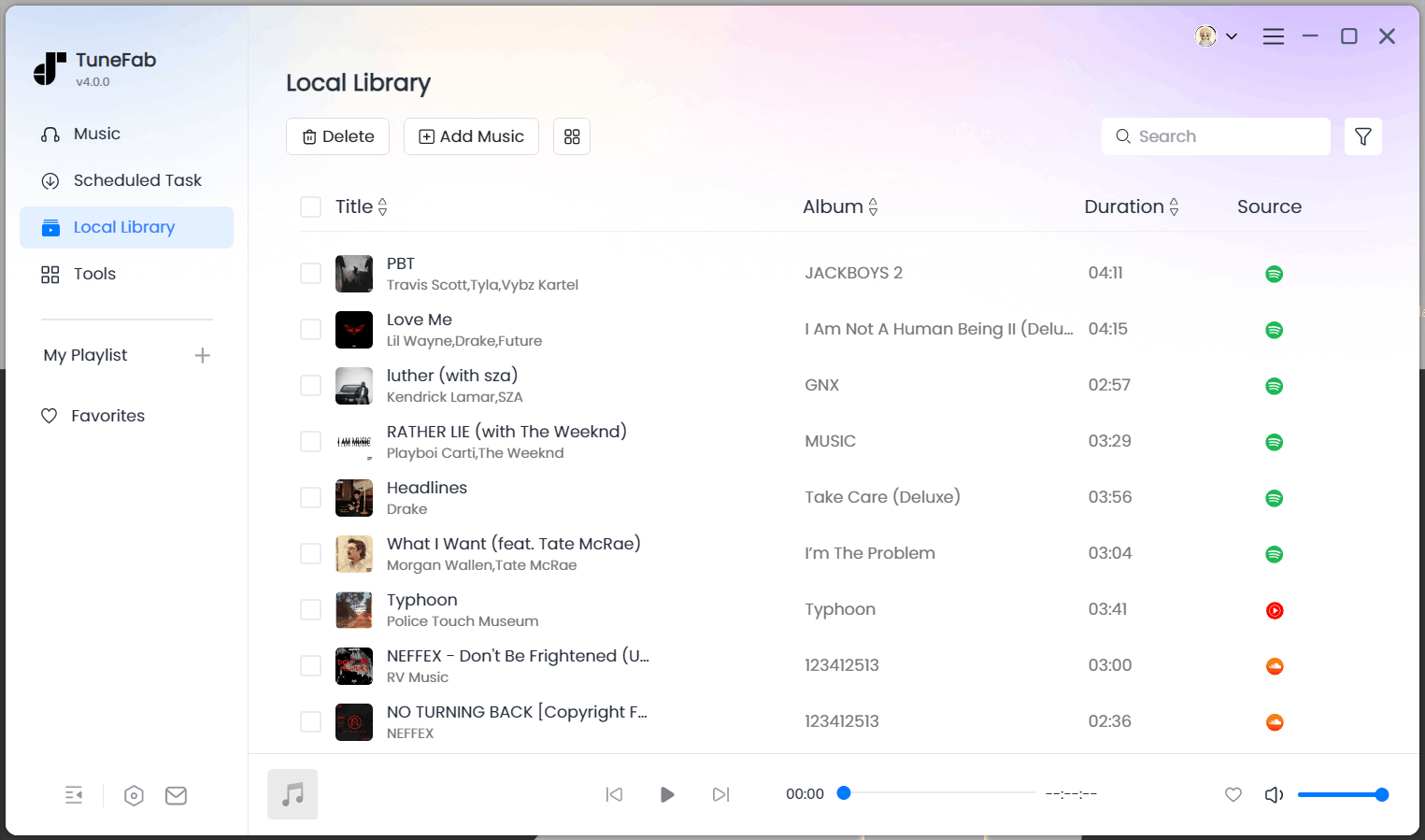
At that point, the next step is simple: export the tracks as regular local files, then move them to the device or app that could not use Apple Music directly.
Which output format should you choose?
Do not ask only, “What format is Apple Music?” Ask instead, “What format does my target device or app accept?”
| Format | Best for |
| MP3 | The widest compatibility across players, cars, older devices, and general offline use |
| M4A / AAC | Smaller files and Apple-friendly workflows |
| ALAC | Lossless quality in Apple-focused setups |
| WAV / AIFF | Editing, production, or other quality-first workflows |
Apple’s own Music/iTunes guide confirms that imported songs can be converted into a chosen encoding format, while Apple’s lossless guide explains that Apple Music now supports ALAC-based lossless audio in much of the catalog.
Need a full walkthrough for the MP3 route? Here is the step-by-step guide to converting Apple Music to MP3 for wider device support.
One small but important note
Do not mix up these three cases:
1. Apple Music app playback
2. Songs imported into Music or iTunes from local files
3. Music you want to use outside Apple Music
They are related, but they are not the same use case. Once you separate them, the “format not supported” error becomes much easier to solve.
FAQs About Apple Music Format Not Supported
Why does Apple Music say “This media format is not supported” on only one song?
Usually because that one downloaded item is broken, incomplete, or temporarily unreadable on your device.
Delete the local download, keep the song in your library, and download it again first.
Is "This media format is not supported by Apple Music" always a real file format problem?
No. Sometimes it is just a playback issue inside Apple Music. Other times it is a compatibility issue between Apple Music and another device, player, or app.
What should I try before using a converter?
Start with the basic fixes first:
- test another connection
- restart your iPhone
- remove and re-download the item
- update iOS
- reset network settings if needed
If the music still works only inside Apple Music and not in your target device or app, a converter becomes a more relevant answer.
What is the safest output format for broad compatibility?
In most cases, MP3. It is usually the easiest choice for car players, older devices, MP3 players, USB playback, and many third-party apps.
Can I convert songs directly in Music or iTunes?
You can convert songs that you import from files into your library based on your import settings. But Apple says older purchased songs encoded in Protected AAC cannot be converted with the built-in method.
Conclusion
If Apple Music says “This media format is not supported,” start with the simple playback fixes first.
In many cases, the problem is a weak connection, a broken download, or a temporary iPhone issue.
If the error mainly shows up outside Apple Music, stop treating it like a basic app bug. At that point, the real problem is usually compatibility, and regular local audio files become the more practical answer. If that is your situation, converting the tracks into regular local files becomes the more practical next step, and TuneFab Apple Music Converter can help you do that more easily.

