


Apple Music provides millions of tracks in high-quality AAC format, but downloaded songs are designed to work primarily within the Apple Music ecosystem. Many subscribers who continue paying for the service still look for a way to convert their Apple Music library to MP3, especially when they prefer using a different music player, transferring songs to another device, or building a fully offline collection.
That said, not every audio converter can properly process Apple Music files. Standard online tools that convert common M4A or AAC tracks often fail due to playback restrictions, and re-encoding between lossy formats may affect sound quality. So today, we will walk you through the best Apple Music converter, helping you find a stable desktop solution that preserves audio quality, supports multiple formats, and works smoothly on both Mac and Windows. Let's get started!
Note: If you are looking for other types of Apple Music converters, just click what you want as follows.
- What Makes the Best Apple Music Converter?
- 3 Best Apple Music Converters for Mac & Windows (In-Depth Review)
- TuneFab Apple Music ConverterHOT!
- ViWizard Apple Music Converter (Same as DRmare & TunePat)
- NoteBurner Apple Music Converter (Same as Sidify)
- Feature Comparison Table (Speed, Quality, Formats & Pricing)
- Final Verdict: Which Apple Music Converter Is Best for You?
- Bonus: FAQs About Using Apple Music Converters
What Makes the Best Apple Music Converter?
With so many Apple Music converters available online, it can be difficult to know which one is actually worth using. Some tools focus on speed, others emphasize audio quality, and many claim to be "the best" without clearly explaining why. To choose the right solution, it helps to evaluate a few key technical factors rather than relying on marketing claims.
When reviewing the best Apple Music converter, these are the most important aspects to consider:
- Compatibility with Apple Music files: Apple Music tracks are delivered in a protected streaming format. A reliable converter should properly process these files and convert them for broader offline playback without playback errors.
- Conversion speed: Modern desktop tools can convert tracks at accelerated speeds (often 10× to 30× faster than real-time). Faster processing is especially useful when converting large playlists or full libraries.
- Audio quality preservation: The best converters maintain the original audio quality as closely as possible, offering high-bitrate MP3 (e.g., 320 kbps) or even lossless output formats such as FLAC or WAV.
- Supported output formats: Flexibility matters. Look for support for popular formats like MP3, AAC, FLAC, WAV, and AIFF to ensure compatibility with different devices and players.
- ID3 tag retention: A good converter should preserve metadata such as artist name, album, track number, and cover art, so your music library stays organized after conversion.
- Stability and playback mode integration: Some converters operate through a web player interface, while others rely on older iTunes-based methods. Web-based integration often provides better stability and fewer sync-related issues.
By comparing these core features, you can identify which desktop tool truly delivers reliable performance and high-quality output. In the next section, we take a closer look at three leading Apple Music converters for Mac and Windows and evaluate how they perform across these criteria.
Disclaimer: The converted Apple Music files are for personal use only. Do not distribute the resultant audio files for commercial purposes.
3 Best Apple Music Converters for Mac & Windows (In-Depth Review)
To better understand how these factors translate into real performance, we tested three established desktop Apple Music converters. While they share similar core functions, their user experience, output flexibility, and efficiency can vary. The following sections break down each tool in detail, all with the free trial version.
TuneFab Apple Music Converter
💡 Best For: Users Who Want Balanced Performance and Value
TuneFab Apple Music Converter is a desktop solution designed for users who want more flexibility when managing and listening to their Apple Music library across devices. Instead of relying solely on the official app environment, it allows you to export tracks into widely supported formats for broader offline playback.
Compared to many similar tools, TuneFab emphasizes processing efficiency, stable web-player integration, and format versatility. Below is how it performs during our tests.
100% Secure
100% Secure
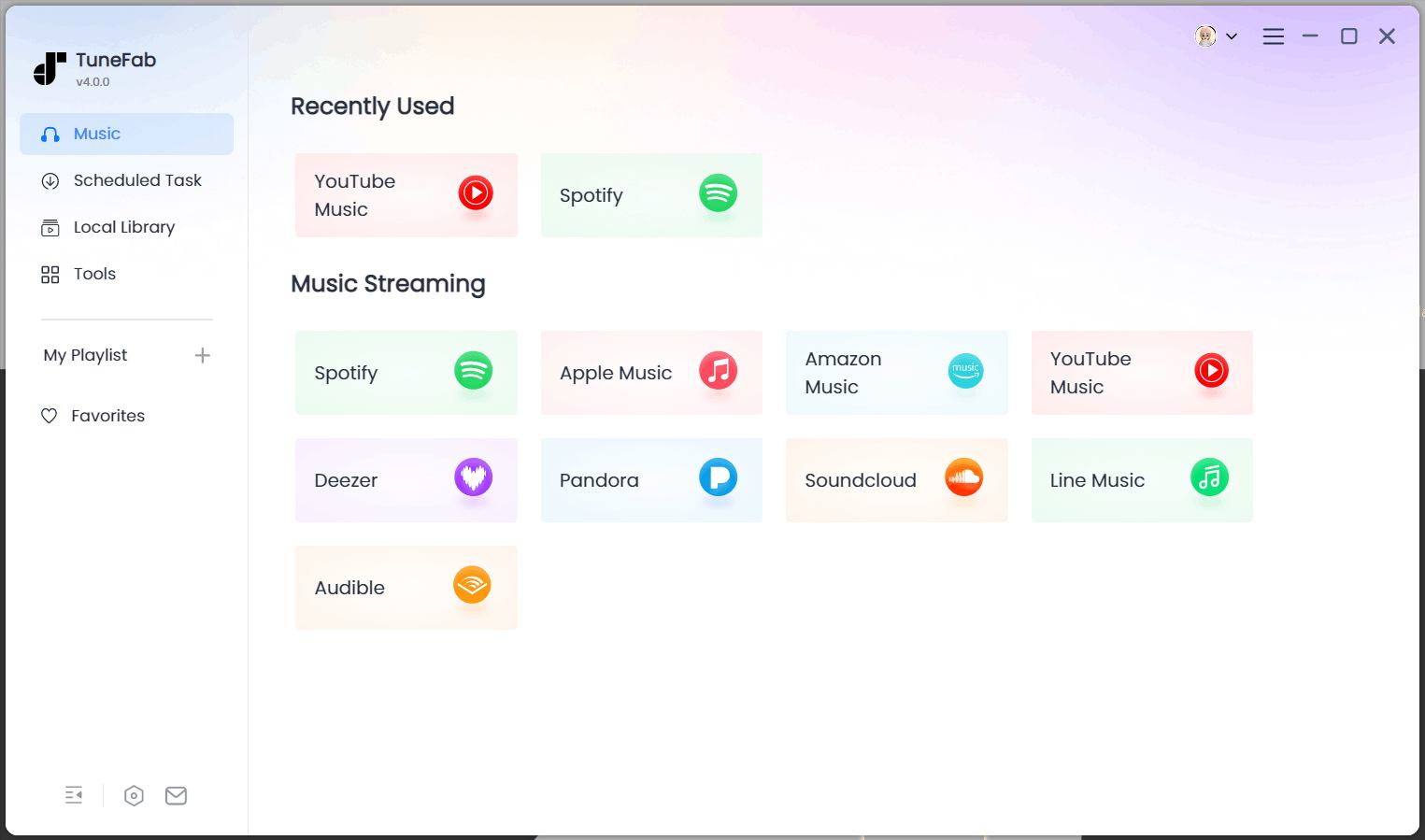
Step 1. After downloading and launching the software, the first thing we noticed was a clean interface with a sidebar listing multiple supported streaming services. We selected Apple Music to proceed.
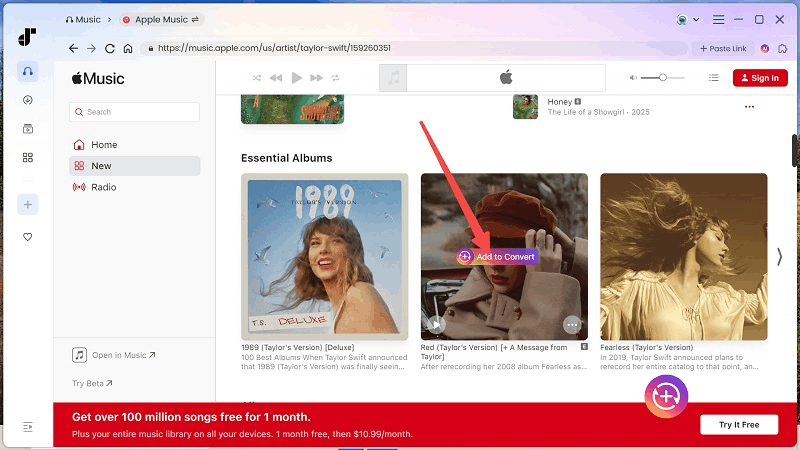
Step 2. The program opened an integrated web-player interface where we could browse playlists, albums, and individual tracks. When hovering over a song or playlist, an "Add to Convert" button appeared, allowing us to quickly add items to the conversion queue.
A little incident: When adding songs, it suggested logging into the Apple Music account for a more stable experience. We chose to skip this step, but the selected tracks were still successfully added to the conversion list without interruption.
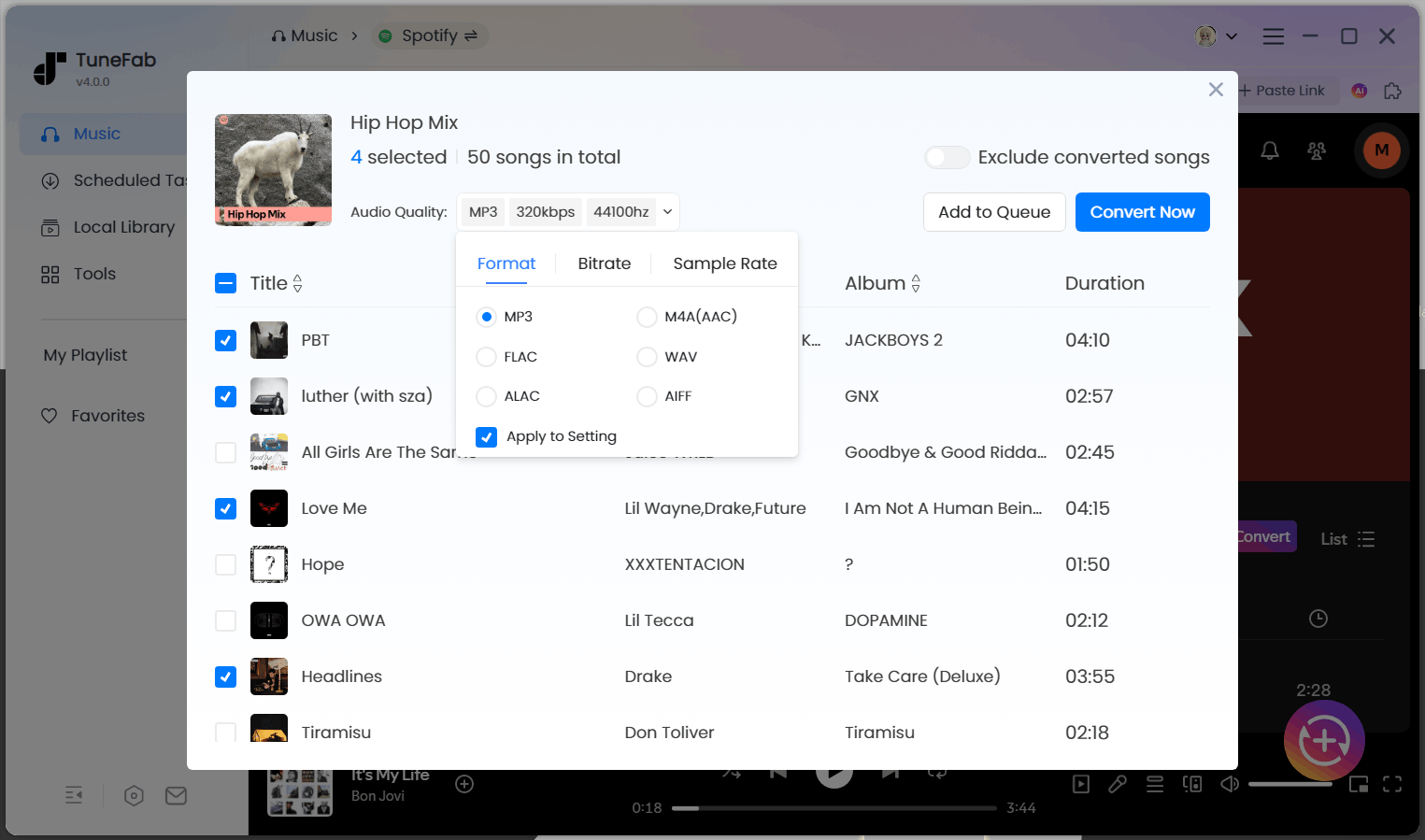
Step 3. In the conversion panel, we selected MP3 as the output format and chose the highest available bitrate (320 kbps). We then added three tracks to test speed performance.
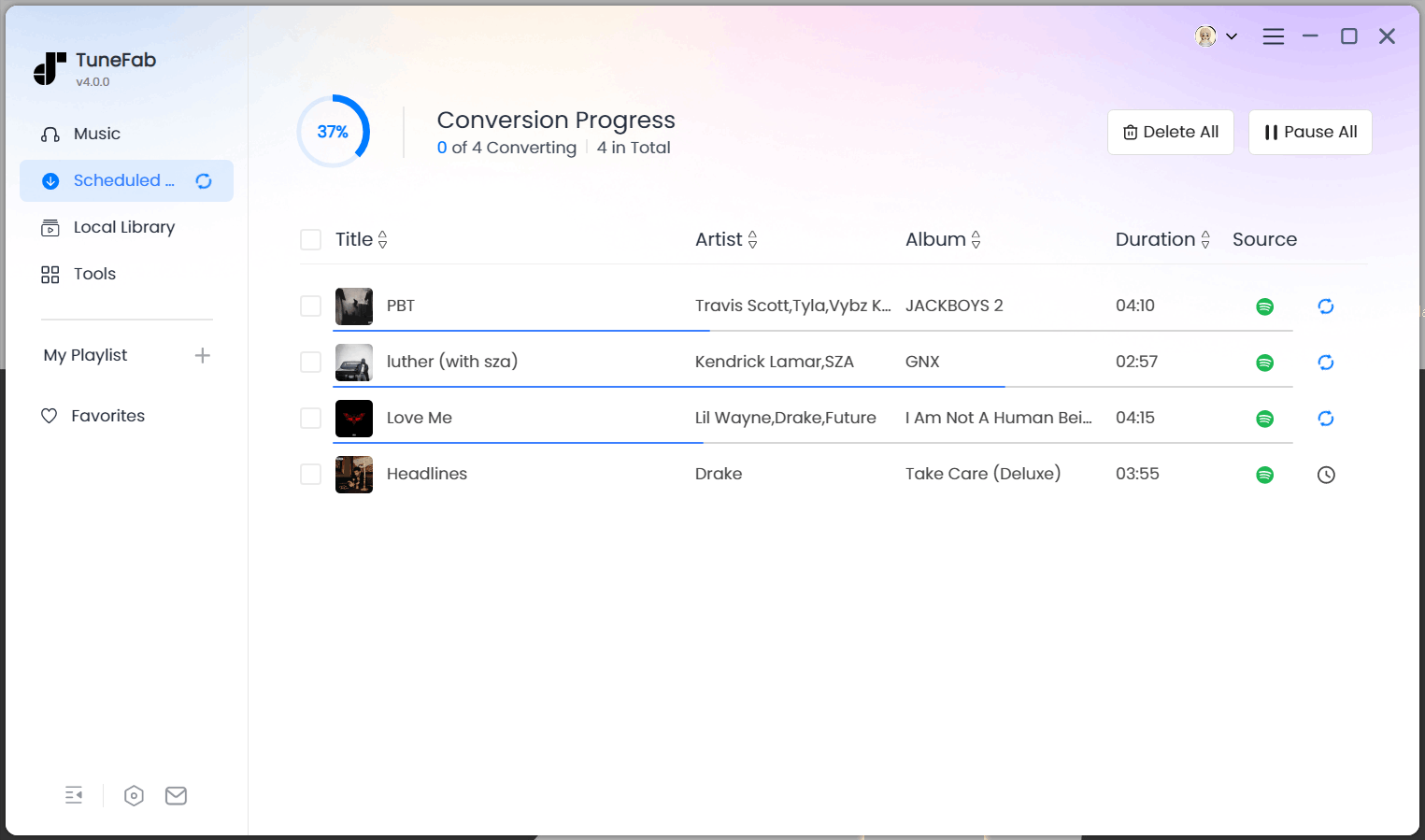
The conversion process took approximately 8 seconds for each song. While the website mentions speeds of up to 35× faster, real-world performance may vary depending on track length and system configuration.
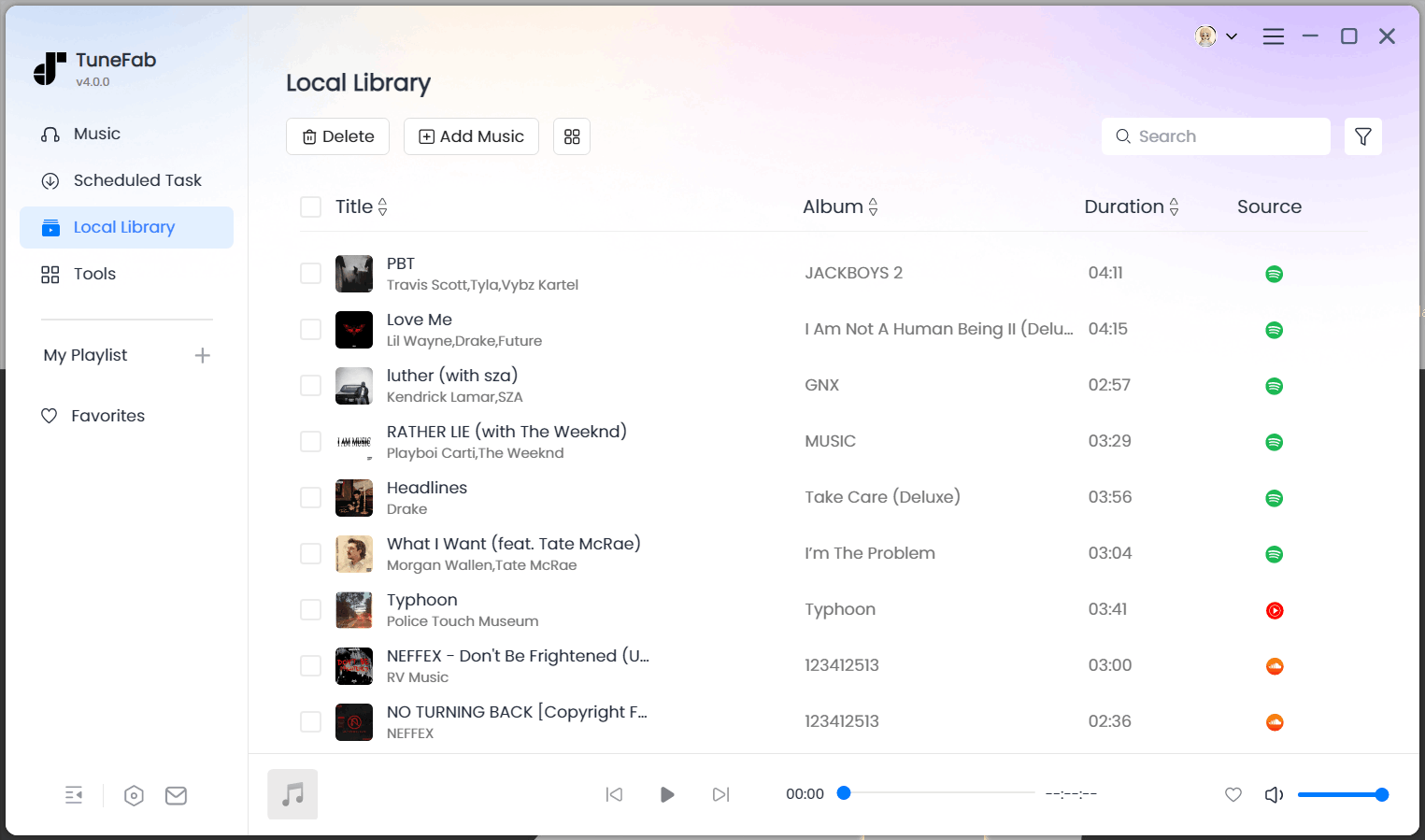
Step 4. Once completed, the files appeared in the built-in Local Library. We were able to preview playback directly inside the software. During the free trial, 3 full tracks were exported without additional restrictions. After that limit, a purchase reminder appeared.
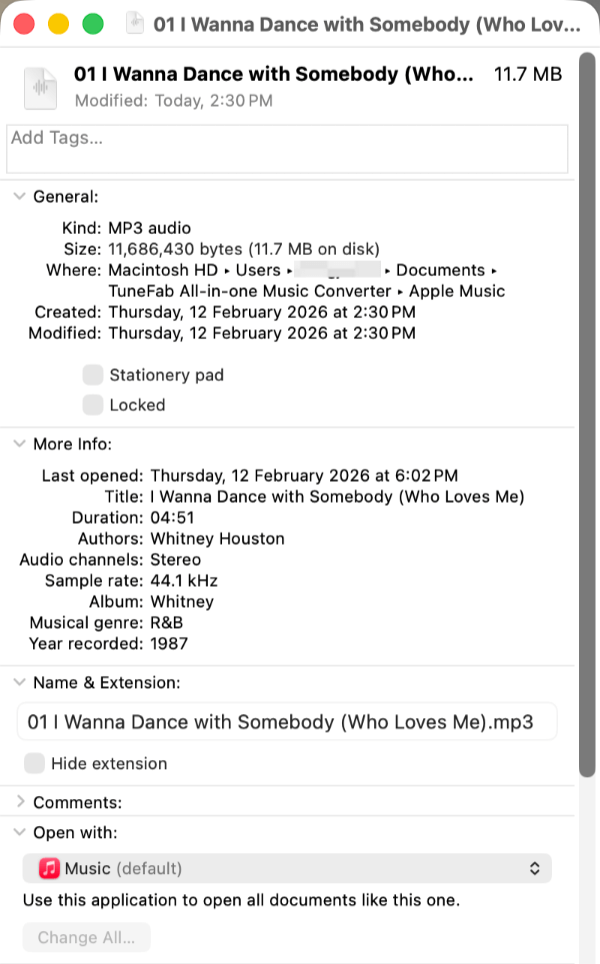
Step 5. We checked the downloaded files using macOS file information. The format and bitrate matched the selected output settings, consistent with what the software claims.
Pros & Cons of TuneFab Apple Music Converter
✅ Pros
- Smooth Web-Player Integration: The built-in Apple Music web player loads directly inside the software. During testing, tracks could be added to convert without login, and it remained stable.
- Fast Batch Processing: The software supports accelerated conversion speeds (advertised up to 35×). In our test, three tracks were processed in roughly 30 seconds, which is not bad.
- Customizable Output Quality: Users can select output formats and adjust bitrate settings (up to 320 kbps for MP3). The exported files matched the selected parameters when verified on macOS.
- Broad Format Compatibility: Supports MP3, M4A, FLAC, WAV, AIFF, and ALAC, allowing playback across Android players, car audio systems, and other third-party apps.
- Metadata Retention: Song information such as artist, album, track title, and cover artwork was preserved in our exported files, helping maintain an organized music library.
🤔 Cons
- Limited Free Trial: The free version allows exporting three full tracks. After that, a purchase prompt appears. Users who want to convert larger playlists will need to upgrade.
- Real-World Speed May Vary: While high-speed conversion is advertised, actual performance may vary depending on system setup and track length.
👉 For More Info: TuneFab Apple Music Converter Review: An Honest Look at Features, Limits, and Use Cases
ViWizard Apple Music Converter (Same Software Family as DRmare & TunePat)
💡 Best For: Casual Users with Basic Conversion Needs
ViWizard Apple Music Converter is part of the same software family as DRmare and TunePat, sharing the same interface and underlying workflow. It is positioned as a desktop solution for converting Apple Music tracks into commonly supported audio formats.
Compared to other desktop converters, ViWizard focuses on a straightforward conversion process with minimal configuration options in the free version. During testing, its behavior was largely consistent with what users would expect from this software group.
We installed it and tested several tracks and playlists under the free trial.
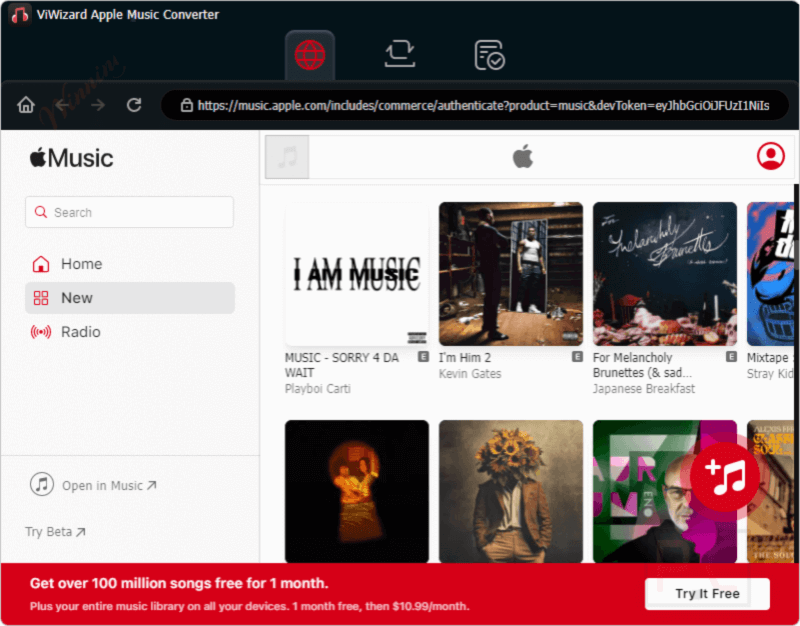
Step 1. After launching the program, we were taken directly to the Apple Music web player interface without selecting a streaming service from a menu. The layout closely resembles the official browsing experience.
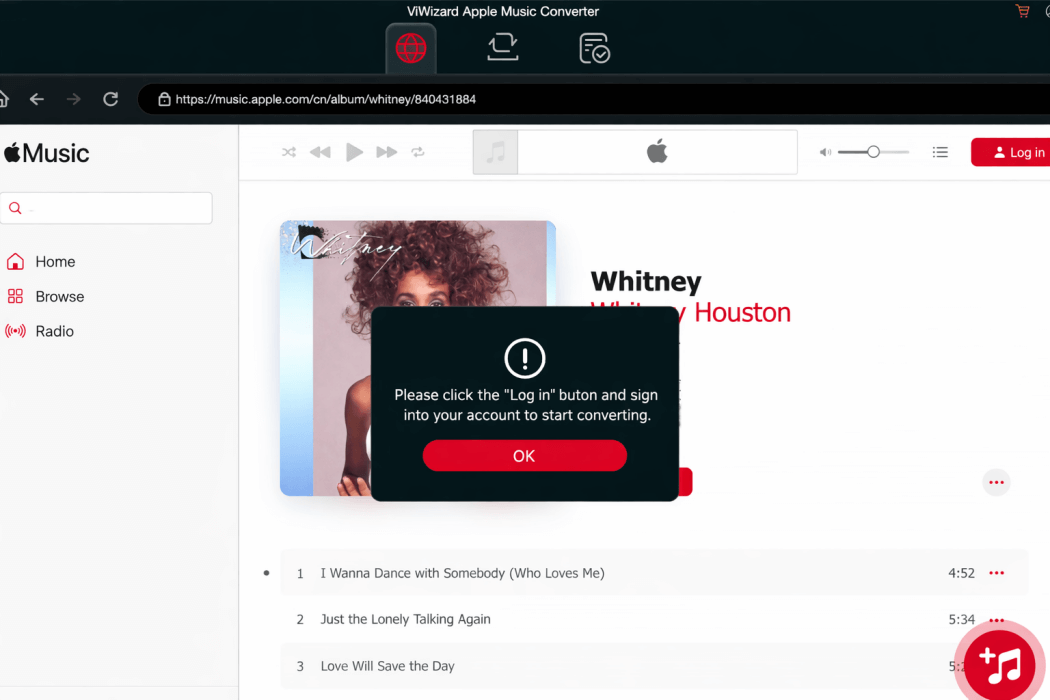
Step 2. When attempting to add tracks without logging in, a pop-up message appeared stating that an Apple Music login was required to add songs. After logging in, tracks could be added to the conversion list normally.
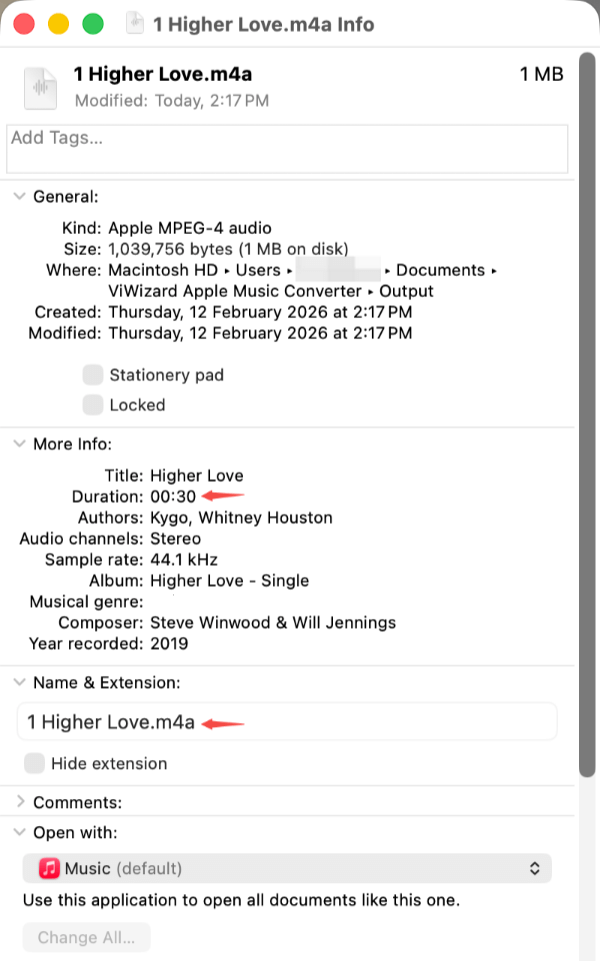
Step 3. Under the free trial, both individual songs and full playlists were limited to 30-second exports. No adjustable settings (such as bitrate or format selection) were available in trial mode.
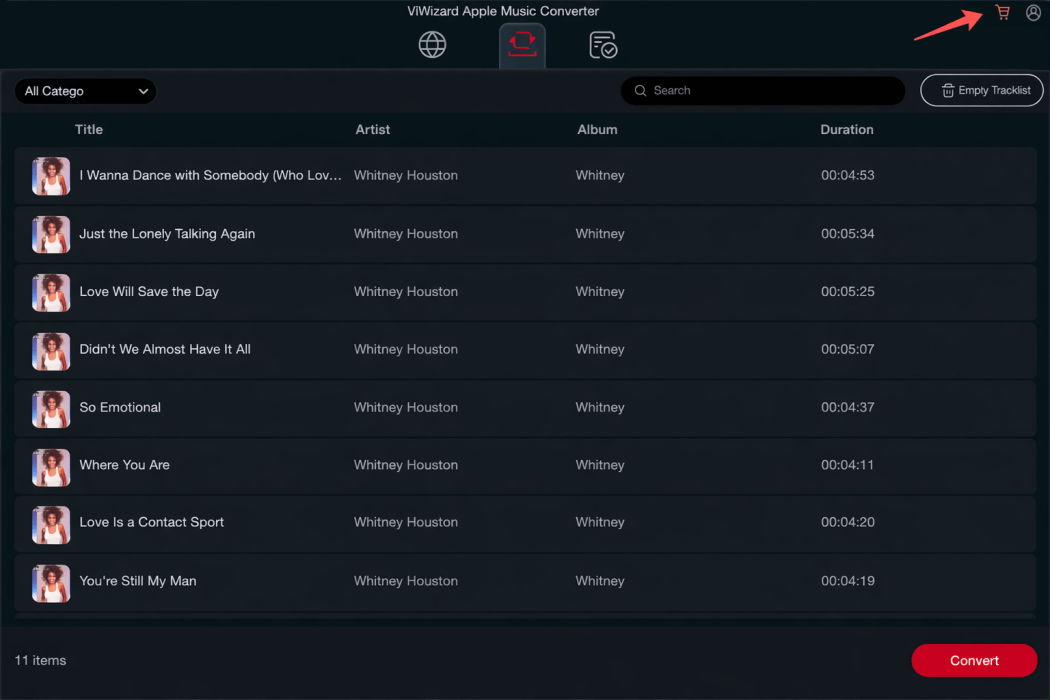
Step 4. After adding songs to the conversion list, clicking "Convert" immediately started processing. A single track took roughly 15 seconds to complete in our test. There was no restriction on the number of tracks added, but each file was capped at 30 seconds.
Step 5. The exported file was saved in M4A format by default (44.1 kHz). ID3 metadata, such as artist, album, and cover artwork, were preserved correctly in the file information.
Pros & Cons of ViWizard Apple Music Converter
✅ Pros
- Simple Web-Based Interface: Direct integration with the Apple Music web player makes browsing and selection intuitive.
- No Track Quantity Limit in Trial: Users can queue multiple tracks or playlists, though each export is limited in length.
- Metadata Retention: ID3 tags and cover artwork were preserved accurately in our test files.
- Part of an Established Software Family: Shares the same technical framework as DRmare and TunePat, resulting in a consistent user experience across these products.
🤔 Cons
- Free Trial Limited to 30 Seconds Per Track: All exported files are capped at 30 seconds unless the software is unlocked.
- No Output Settings in Trial Mode: Bitrate, format selection, and other customization options are unavailable before purchase.
- Speed & Audio Stability May Vary: Some user reviews online report inconsistent conversion speeds and occasional audio skips at higher acceleration settings. While we did not encounter skips during short trial testing, long-term performance may depend on system configuration and settings.
NoteBurner iTunes Music Converter (Same Software Family as Sidify)
💡 Best For: Users Who Prioritize Flexible Settings Over Speed
NoteBurner iTunes Music Converter shares the same software framework as Sidify, with a nearly identical interface and workflow. Both products operate through a web-based Apple Music interface and offer similar conversion modes and output settings.
Compared to other desktop converters, NoteBurner provides more visible customization options in its interface, even in trial mode. During testing, it offered flexible configuration settings but showed noticeable limitations under the free version.
Here's how we tested it and its performance on several tracks using the free trial.
Step 1. Upon launching the software, we were taken directly into the Apple Music web player interface, without a platform selection step.
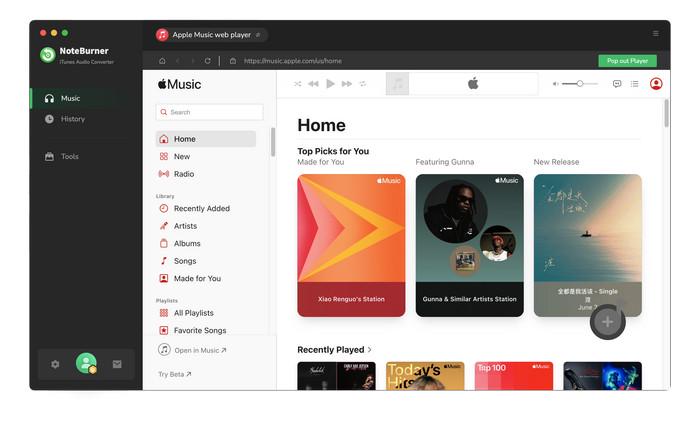
Step 2. When adding tracks, the software prompted us to log in for a more stable experience. However, we were able to skip login and still add songs to the conversion queue.
Step 3. In the conversion queue, three processing modes were available: "Record Mode", "YouTube Mode", and "Intelligent Mode". Even in trial mode, the software allowed output format customization. We selected "MP3" for testing.
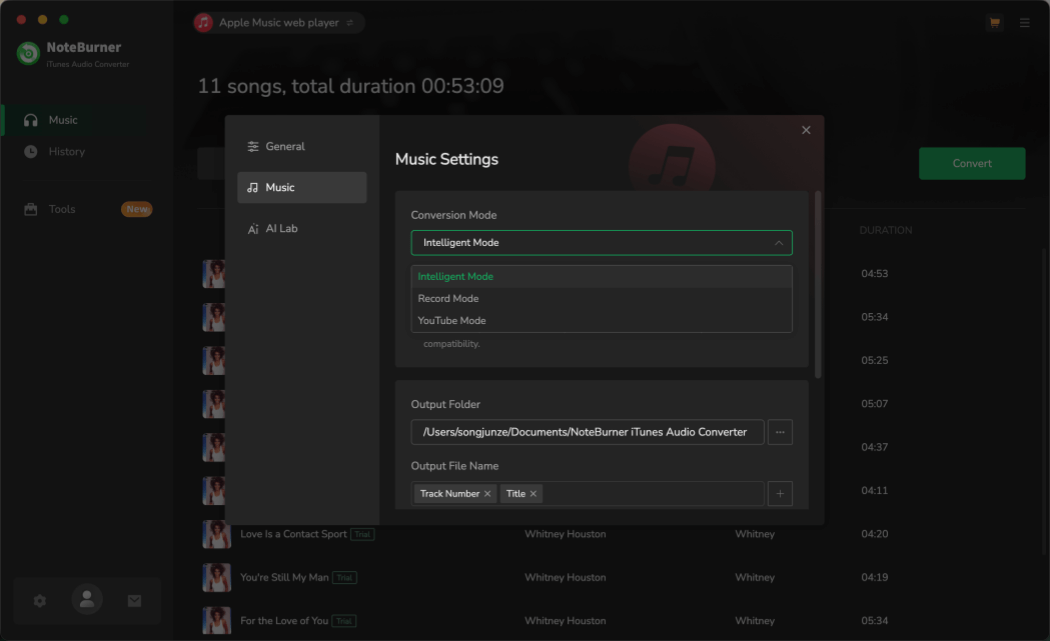
Step 4. After clicking "Convert," a purchase reminder appeared. The free version supports exporting only the first 60 seconds of any track. During our test, converting a single song took nearly one minute to complete, even though only one minute of audio was exported. Actual performance may vary depending on system and network conditions.
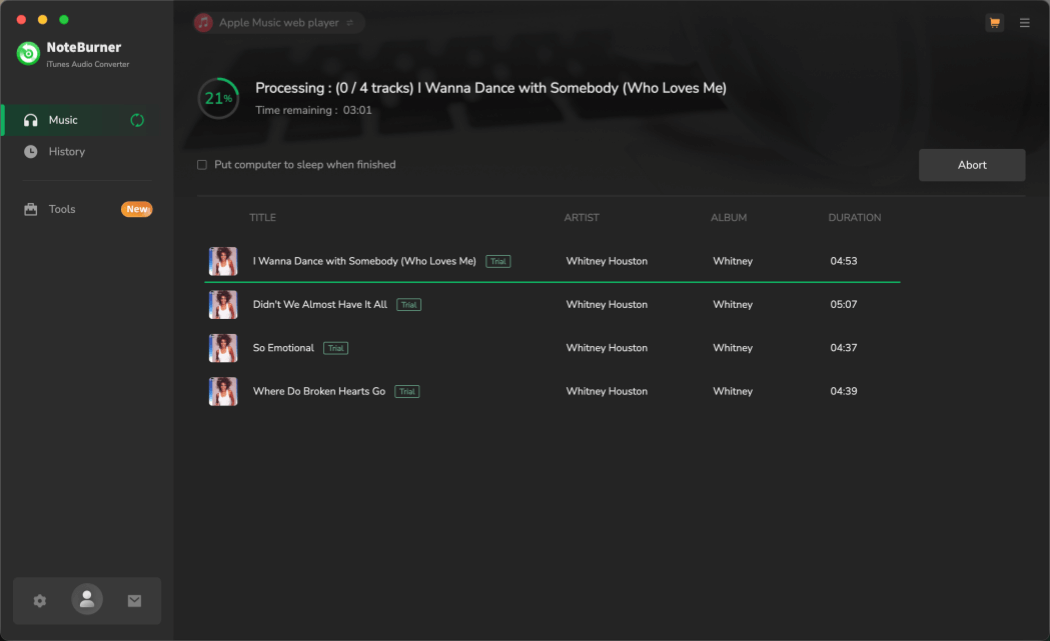
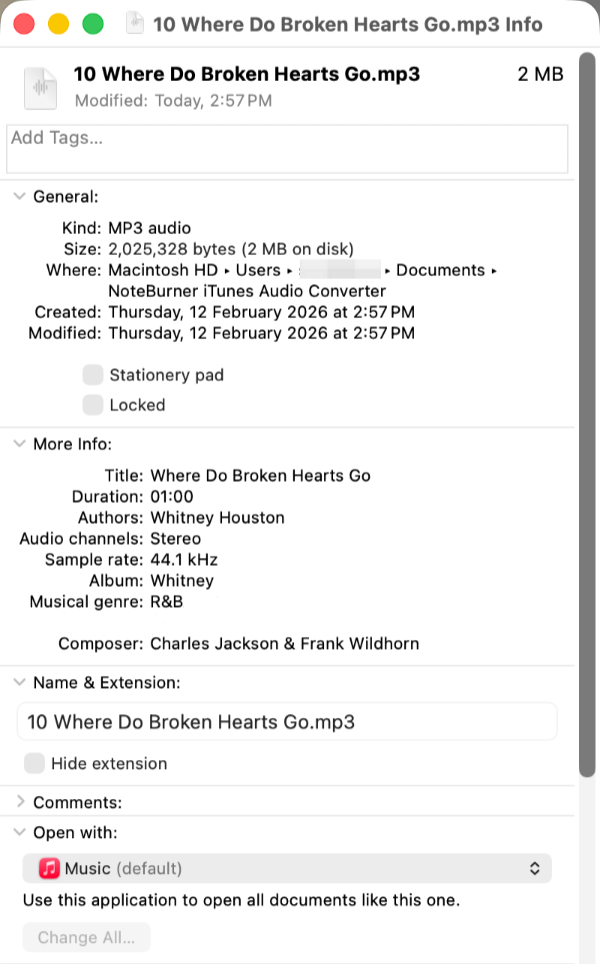
Step 5. The exported file (MP3 format, 44.1 kHz) matched the selected settings. ID3 metadata, including album art and track information, was preserved correctly.
Pros & Cons of NoteBurner iTunes Music Converter
✅ Pros
- Multiple Conversion Modes Available: Offers Record, Intelligent, and YouTube modes, giving users different processing approaches.
- Output Settings Accessible in Trial: Even in free mode, users can select output formats (e.g., MP3) and view available configuration options.
- Metadata Retention: Artist name, album title, and cover artwork were preserved correctly in our exported test files.
- Established Software Framework: Shares the same technical structure as Sidify, providing a familiar and consistent user interface.
🤔 Cons
- Free Trial Limited to 60 Seconds Per Track: Only the first minute of each song can be exported before upgrading.
- Processing Speed May Approach Real-Time: In our test, exporting one minute of audio took close to one minute to complete. Actual performance may vary depending on system and network conditions.
- Separate Licensing for Windows and Mac: Licenses are typically platform-specific.
- Uncertainty Around Audio Fidelity Claims: While the software offers high-quality format options, some users question whether the output fully matches the source stream. Independent verification may be advisable for critical listening use cases.
Feature Comparison Table (Speed, Quality, Formats & Pricing)
Each of the three desktop tools reviewed above can export Apple Music tracks for broader offline playback, but their real-world performance and trial limitations differ significantly. Some prioritize faster batch processing, others focus on visible configuration options, while free version restrictions vary from 30 to full length per track.
To help you choose based on practical needs rather than marketing claims, the table below compares them across key user-focused criteria.
| User Priority | TuneFab | ViWizard (Same as DRmare & TunePat) | NoteBurner (Same as Sidify) |
| Processing Speed (Full Version) | Up to 35× acceleration | Advertised high-speed processing | Varies by mode; may approach real-time |
| Tested Trial Version Performance | ~8 sec per track (full song) | ~15 sec per 30-sec clip | ~1 min to export 1 min |
| Free Trial Limitation | 3 full tracks | Unlimited tracks, 30 sec each | Unlimited tracks, 60 sec each |
| Output Format Options (Trial) | Format selection available (MP3, FLAC, WAV, etc.) | Not adjustable in trial | Format selection available (MP3, FLAC, WAV, etc.) |
| Audio Quality Control | Custom bitrate (up to 320 kbps), supports lossless formats | Default output in trial (M4A 44.1 kHz) | Adjustable output settings available |
| Metadata Retention | Preserves full ID3 tags & artwork | Preserves full ID3 tags & artwork | Preserves full ID3 tags & artwork |
| Web Player Integration | Stable built-in interface | Built-in web player | Built-in web player |
| Pricing & License Model | Monthly ($25.95), Yearly ($79.95), Lifetime ($99.95); 7-day refund | Monthly ($19.95), Yearly ($49.95), Lifetime ($89.95); 14–30 day refund | Yearly (~$44.95), Lifetime (~$89.90); 5–30 day refund |
| Best For | Balanced performance & value | Simple, straightforward workflow | Prefer flexible settings over speed |
Final Verdict: Which Apple Music Converter Is Best for You?
Choosing the best Apple Music converter ultimately depends on what you value most: speed, flexibility, simplicity, or pricing structure.
If you want a straightforward workflow and only need basic functionality, ViWizard (along with its related versions) provides a clean interface and predictable behavior. It may suit users who prefer minimal setup and are comfortable with the trial's 30-second export limitation.
If you prefer seeing multiple processing modes and exploring format settings before committing to a purchase, NoteBurner offers visible configuration options even in its free version. However, trial exports are limited to 60 seconds per track, and real-world processing speed may vary depending on system conditions.
For users who prioritize batch efficiency, stable web-player integration, and balanced performance across speed, output quality, and usability, TuneFab provides a more complete experience. While its pricing is slightly higher than some alternatives, the ability to export full tracks during trial and the overall processing stability may justify the difference for those converting larger playlists or building a long-term offline library.
In short:
- Choose ViWizard if you want simplicity.
- Choose NoteBurner if you want to test configuration options first.
- Choose TuneFab if you're looking for a more balanced and efficient solution for regular use.
Ultimately, the best Apple Music converter is the one that aligns with your listening habits, device needs, and how often you plan to convert your music.
Tip: TuneFab currently offers a 10% discount with the code TFWELCOME for new users. You can check the official pricing page for the latest availability.
FAQs About Using Apple Music Converters
Is It Legal and Safe to Use an Apple Music Converter?
The legality of using an Apple Music converter depends on your local copyright laws and how the tool is used. In many regions, downloading or exporting music for personal, non-commercial use may fall into a gray area, while redistributing or sharing converted files is generally not permitted. Users are responsible for ensuring that their actions comply with applicable laws and the terms of their streaming subscription.
It’s also important to understand that streaming services apply playback protections to control how their content is accessed. Converters are designed to process streaming audio for broader offline compatibility, but they should only be used responsibly. This typically means converting music for private listening purposes rather than commercial distribution.
From a safety perspective, desktop converters from established vendors are generally safer than unknown web-based tools, which may contain intrusive ads or hidden risks. As with any software that requires account access, users should download programs from official sources and consider standard security practices, such as updating passwords after use.
Are free Apple Music converters safe and good?
Free Apple Music converters vary widely in quality and reliability. Many web-based tools either fail to process protected streaming files or impose strict limits on output duration and audio quality. Some may also include aggressive advertising or require suspicious permissions.
Desktop trial versions like TuneFab from established software providers tend to be more stable, though they usually limit export length (e.g., 30 or 60 seconds). If you only need to test functionality before purchasing, these trial versions are generally safer than unknown online services.
Does Apple Music Converter lose audio quality?
Audio quality depends on the output settings selected and the conversion method used. Most desktop converters allow users to choose bitrate and format, such as MP3 (up to 320 kbps) or lossless formats like FLAC and WAV.
Keep in mind that converting between compressed formats may introduce minor quality differences, while exporting at higher bitrates typically preserves sound characteristics more closely. For everyday listening on mobile devices or car systems, high-bitrate MP3 files are usually sufficient. For more critical listening setups, users may prefer lossless formats when available.
TuneFab Apple Music Converter
Try TuneFab as the best Apple Music converter for better user experiences!

