


As you build your Apple Music library, you might worry about losing your playlists if you switch devices or your subscription expires. Downloading Apple Music songs might seem like a solution, but these downloads are just cached and will become unavailable if you leave the Apple Music platform or Apple devices, as Apple Music is not a backup service.
This guide shows how to backup Apple Music and how to backup your Apple Music library with a quick decision table and simple methods. It also helps you restore things if anything goes wrong.
- Before You Start: What Does “Apple Music Backup” Actually Mean?
- Quick Decision: Which Backup Method Fits Your Goal?
- Method 1: Use Sync Library to Backup Apple Music
- Method 2: Export Playlists / Library Metadata to Backup Apple Music
- Method 3: Make a Real Apple Music Backup on Your Computer
- How to Restore Your Apple Music Library
- FAQs about Backup Apple Music Library
- Conclusion
Before You Start: What Does “Apple Music Backup” Actually Mean?
I’ve noticed many users get frustrated because they think they’ve backed up their music, only to find the files won't play later. To avoid that, you need to understand the three ways Apple Music handles your data. They aren’t created equal.
1. Playlists and Library Metadata (The "Map")
Think of this as the digital blueprint of your collection. It includes your playlists, star ratings, and album info. Backing this up lets you restore your library’s structure in seconds, but—and this is a big "but"—it doesn't save the actual music files. If a song is removed from the streaming catalog, this backup won't bring the audio back.
2. Local Audio Files (The "Real" Backup)
These are the MP3s, WAVs, or AAC files actually sitting on your hard drive (like music you’ve ripped from CDs or bought from the iTunes Store). If you copy these to an external drive or a cloud service like Dropbox, you have a permanent, physical backup. This is the only way to truly "own" your music forever.
3. App Downloads (The "Offline" Trap)
This is where most people get tripped up. Clicking the "Download" button inside the Apple Music app is only for offline listening. These files are encrypted (DRM protected) and tied to your subscription. If you sign out, cancel your plan, or move the files to a non-Apple device, they simply won't play.
Quick Tip: If your goal is to play your music on any device without a subscription, you’re looking for a "Real Backup."
Now that we’ve cleared that up, use the decision table below to find the exact method that fits your needs.
Quick Decision: Which Backup Method Fits Your Goal?
Before diving into the steps, identify your primary goal. Most users make the mistake of assuming "Sync Library" or "App Downloads" are permanent. They aren't. Use the table below to find the method that actually protects your music.
| If Your Goal Is To... | What You’re Actually Saving | Works After Subscription Ends? | Recommended Method |
| Fix "Missing Apple Music Songs" | A Synced View (A cloud-based list, not a physical backup) |
⚠️ No (Access requires an active sub) | Method 1: Use Sync Library |
| Restore your Apple Music library layout | Metadata Only (The "Map" of your library, not the audio) |
✅ Yes (Usually) | Method 2: Exporting Library Metadata |
| Secure your personal Apple Music collection | Actual Audio Files (MP3/AAC stored on your hard drive) |
✅ Yes | Method 3 (Part A): Backing Up Local Files |
| Unlock your Apple Music forever | Standard Files (MP3/FLAC/WAV converted to local storage) |
✅ Yes (Permanent access) | Method 3 (Part B): Convert & Save as Local Files |
Quick takeaway: Don't rely on syncing alone. If you want a backup that lasts, Method 2 and Method 3 are your only real options.
Method 1: Use Sync Library to Backup Apple Music
If you just want your playlists and library to look the same on your iPhone, Mac, and iPad, Sync Library is your best friend. It’s the easiest way to cut down those “missing songs” and “playlist not syncing” headaches. But remember, Sync Library is mainly for syncing your library across devices, not for creating a permanent backup.
On Mac
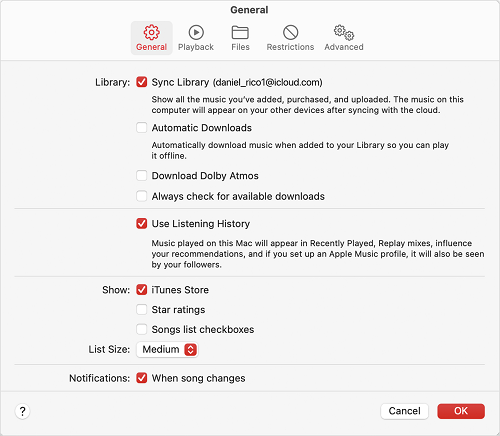
Step 1: Launch the Music app on your Mac.
Step 2: In the top menu bar, navigate to Music > Settings (or Preferences).
Step 3: Under the General tab, make sure the Sync Library box is checked.
On Windows PC (iTunes)
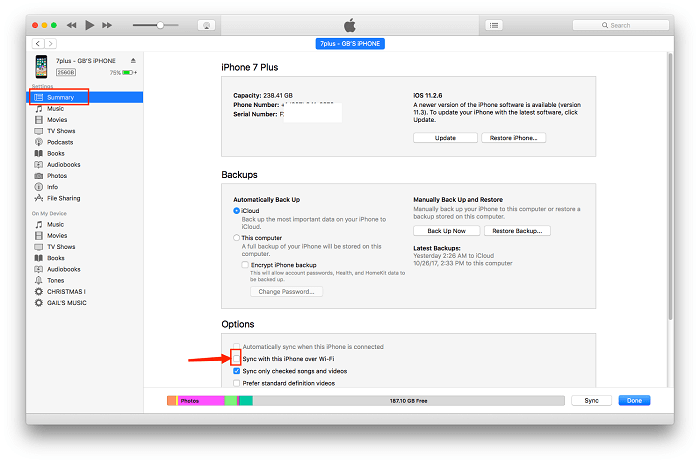
Step 1: Open iTunes on your computer.
Step 2: Go to Edit in the top menu and select Preferences.
Step 3: On the General tab, look for iCloud Music Library and check the box. Click OK to finish.
On iPhone or iPad
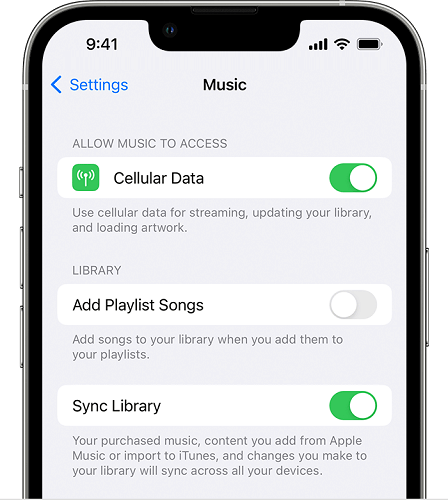
Step 1: Open the Settings app.
Step 2: Scroll down to find and tap Music.
Step 3: Toggle the Sync Library switch to the On (green) position.
Don’t see Sync Library?
Make sure you’re signed in with the same Apple Account, and you have an Apple Music subscription (or iTunes Match). On Windows, the setting may be in the Apple Music app (not iTunes).
Method 2: Export Playlists / Library Metadata to Backup Apple Music
If you want to back up your playlists and the structure of your library, exporting it as an XML file is the best option. This allows you to restore the organization of your library later, even if the music itself is missing or changed.
What you get (and what you don’t)
✅ Included: All playlist names, song orders, and library metadata in XML format.
❌ Not included: Playable audio files (this does not save the actual songs).
On Mac
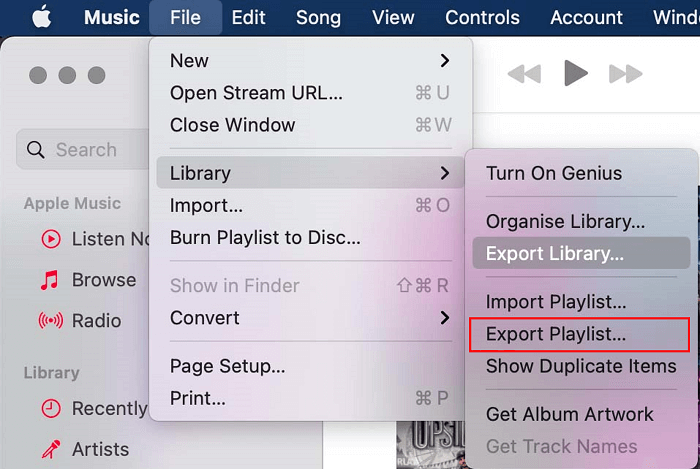
Step 1: Open the Music app.
Step 2: In the top menu bar, select File > Library.
Step 3: Click Export Library... (or choose Export Playlist... for a specific list).
Step 4: Select a secure destination, such as an external drive or cloud storage, and click Save.
On Windows PC (iTunes)
Step 1: Open iTunes.
Step 2: Go to File > Library.
Step 3: Select Export Library... or Export Playlist....
Step 4: Save the generated file to a secure location.
Method 3: Make a Real Apple Music Backup on Your Computer
The definition of a "real backup" is simple: it consists of actual audio files that can be copied to an external drive and restored independently. If the files are tied to an app, they aren't a permanent backup.
So this method has two parts:
- Part A: Back up the music files you already have on your computer
- Part B: If you want music you can keep forever, you’ll need music you actually own as files
Part A: Backing Up Your Local Music Files
This is for music that already resides on your hard drive—such as songs ripped from CDs, purchased from the iTunes Store, or imported from other sources. This type of music can be easily copied to an external drive as a permanent backup.
Step 1: Consolidate your library (Optional but Recommended)
This gathers all scattered tracks into one central folder so nothing gets left behind.
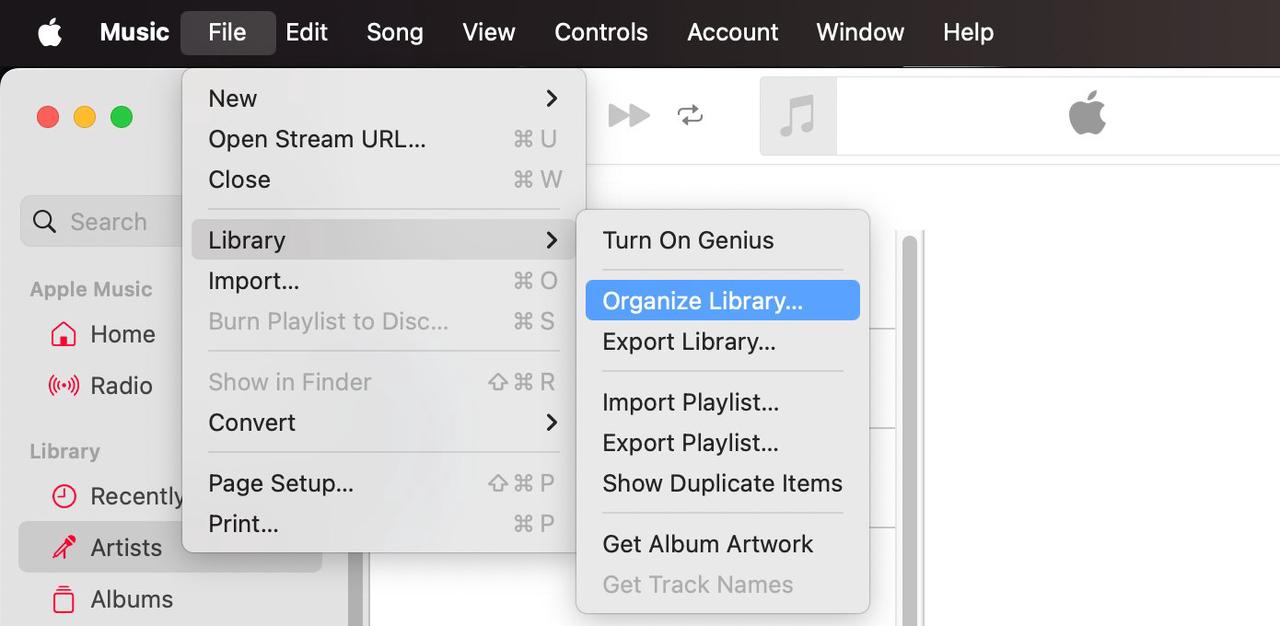
- On Mac: Go to File > Library > Organize Library and select Consolidate files.
- On Windows (iTunes): Go to File > Library > Organize Library and check the Consolidate files box. Click OK.
Step 2: Locate your Media folder
- Mac: Usually found in
User > Music > Media. - Windows (iTunes): Usually found in
User > Music > iTunes > iTunes Media.
Step 3: Copy to an external drive
Connect your external hard drive and copy the entire Media (or iTunes Media) folder to it.
Step 4: Verify the backup
Ensure the folder contains the actual .m4a or .mp3 files, not just empty folders or shortcuts.
Part B: Converting Apple Music to Permanent Files
If your goal is to back up songs from the Apple Music streaming catalog for offline use, you’ll need to convert them into DRM-free files. Standard copying won’t work because these tracks are protected by DRM.
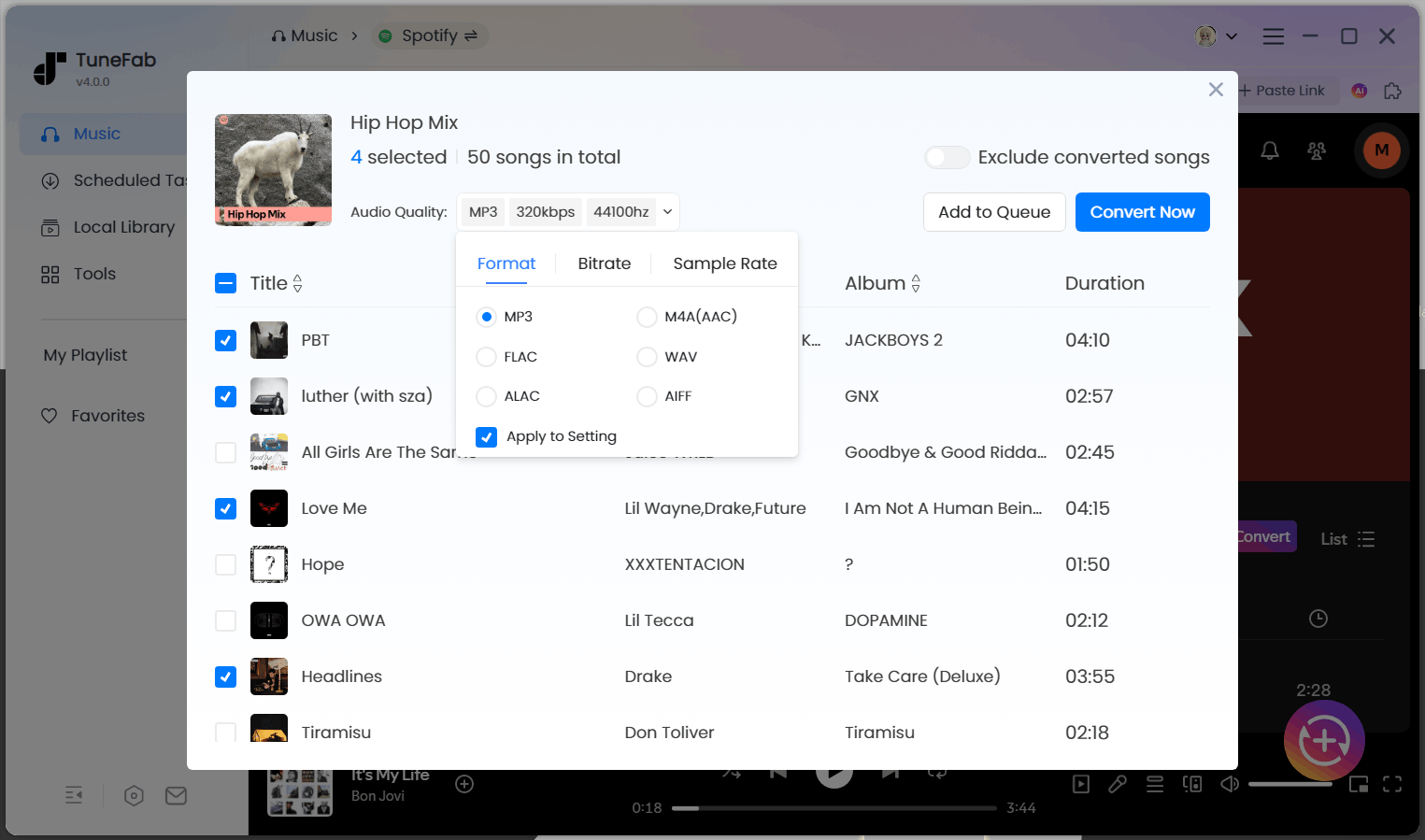
To turn these tracks into real, local files, a specialized tool is required. TuneFab Apple Music Converter is a highly recommended solution for this. It will help you keep all your Apple Music songs, playlists, and albums on your computer by downloading Apple Music to MP3, M4A, and other widely supported formats. After that, you can move those DRM-free Apple Music downloads to mobile phones, tablets, or other devices, even after canceling your Apple subscription.
How it works in 3 quick steps:
Step 1: Launch TuneFab and sign in to the web player to access your library.
Step 2: Select the playlists or albums you wish to back up and choose your output format (MP3 is best for universal compatibility).
Step 3: Click Convert. The software removes the encryption and saves the tracks directly to your computer as local audio files.
By converting your catalog into local files, you move from "renting" your music to truly owning it. This is the only way to ensure your Apple Music library remains playable on any drive, at any time. If you require permanent files to store in a specific place/format, these specialized guides will walk you through the process:
- Desktop: Download Apple Music on Mac / Windows ...
- Format: Apple Music to MP3 / FLAC / WAV ...
- Device: Apple Music to USB / Hard Drive ...
How to Restore Your Apple Music Library
The value of an Apple Music backup is only realized when you need to use it. If your library goes missing or your playlists vanish, the recovery path depends entirely on the backup method you chose.
- If you used Sync Library: Your goal is to re-establish the connection to Apple's servers. A simple sign-in and toggle usually re-syncs your library view across all devices.
- If you exported XML metadata: You are restoring the "map." By importing that XML file, you can instantly rebuild your playlists and library structure, provided the songs are still in the catalog.
- If you backed up local files: You are restoring the "soul" of your collection. This involves moving your saved Media folder back to your computer and pointing the Music app or iTunes to the correct path.
Because the restoration process involves specific technical steps for each scenario, it requires a dedicated deep dive to ensure no data is lost during the transfer. For more instructions, you can read the full restore guide: How to Restore Apple Music Library >
FAQs about Backup Apple Music Library
Does Sync Library count as an Apple Music backup?
Not really. Sync Library is for syncing, not for making an Apple Music backup file. It helps keep your library and playlists consistent across devices, but it doesn’t give you a copy you can store and restore from a hard drive.
Can I put my entire Apple Music library on iCloud?
It depends on what you mean by “entire library.”
- If you mean your Apple Music library view (playlists, saved songs), Sync Library can keep it in sync across devices.
- If you mean real music files you can keep forever, Apple Music won’t give you one big iCloud folder of playable Apple Music files. For true backups, you need files you already have on your computer (then copy them to an external drive or a cloud drive folder).
What happens to my library when my subscription expires?
When your subscription ends, you can lose access to Apple Music streaming songs, and your in-app downloads can stop playing. That’s why it helps to export your playlists (Method 2) and back up any real local music files you have (Method 3).
Why are songs missing after enabling Sync Library?
Most of the time, it’s one of these: it’s still syncing, you’re on different accounts, or your connection is unstable. Make sure every device uses the same Apple Account, stay on Wi-Fi, and give it a few minutes. Big libraries can take longer.
How do I export my Apple Music library (playlists)?
On Mac or iTunes for Windows, export playlists from the menu: File > Library > Export Playlist. This saves your playlist “map” (song lists and library info), not permanent Apple Music song files.
How do I backup my Apple Music library to an external hard drive?
If you want a real backup, back up local music files on your computer. Copy your Music/Media folder (or iTunes Media folder) to an external drive and keep it as a dated snapshot. That’s the easiest way to restore files later.
Can I back up Apple Music on an Android / SD card?
You can download songs for offline listening in the Android app, and you might store that offline data on an SD card. But those are still in-app downloads, not normal music files you can play anywhere. Think “offline access,” not “true backup.”
Conclusion
You now know how to backup Apple Music the right way. Syncing keeps your library consistent, exporting saves your playlist “map,” and a real backup means real files you can store and restore anytime. Just pick the method that matches your goal.
If your goal is a real Apple Music backup you can keep on your computer, hard drive, or USB, the fastest next step is to save your Apple Music as local files with TuneFab Apple Music Converter.

