


If you are trying to save storage space on your device or make your music library more portable, converting Apple Lossless (ALAC) to AAC can be a practical choice. While ALAC keeps full audio quality, its large file size is not always ideal for everyday listening on iPhone, iPad, or other portable devices. AAC, on the other hand, offers a good balance between file size and sound quality, making it more suitable for daily playback and syncing.
However, the way you convert depends on what kind of music you have. If your Apple Lossless files are already stored locally, you can use the Apple Music app or iTunes to convert them to AAC directly. But for Apple Music streaming tracks, which are protected and not saved as standard audio files, you will need a different method. In the following sections, we will walk you through both options step by step so you can choose the right solution for your needs.
- Apple Lossless vs AAC: What's the Difference?
- Method 1. Convert Apple Lossless to AAC in Apple Music or iTunes
- Method 2. Convert Apple Music Streaming Songs to AAC via TuneFab
- Bonus Tips: Best AAC Settings (Bitrate and Encoder Explained)
- FAQs About Converting Apple Lossless or Apple Music to AAC
- Conclusion
Apple Lossless vs AAC: What's the Difference?
Apple Lossless (ALAC) and AAC are designed for different listening needs, even though they often use the same .m4a file extension. ALAC preserves all original audio data for maximum sound quality, while AAC uses compression to reduce file size and improve efficiency for everyday playback.
Here are the key differences that matter most in real use:
- File size: AAC files are significantly smaller than Apple Lossless files, making them easier to store and transfer across devices.
- Audio quality: ALAC keeps full, lossless quality, while AAC removes some audio data during compression, although the difference is often hard to notice in daily listening.
- Use cases: AAC is better for mobile devices, streaming, and saving storage space, while ALAC is more suitable for archiving or high-quality playback.
- Compatibility: AAC is widely supported across almost all devices, while Apple Lossless is mainly used within Apple ecosystems.
In practice, converting Apple Lossless to AAC is not about improving sound quality, but about reducing file size and making your music library more flexible. If AAC better matches your needs, you can choose the appropriate method below depending on whether your music files are local or from Apple Music streaming.
Related Reading: Apple Lossless vs FLAC: What's the Difference?
Method 1. Convert Apple Lossless to AAC in Apple Music or iTunes
If your music files are already stored locally as Apple Lossless (ALAC), you can convert them to AAC directly using the Apple Music app on Mac or iTunes on Windows. This is the official method provided by Apple and works for songs in your library, folders, or imported files.
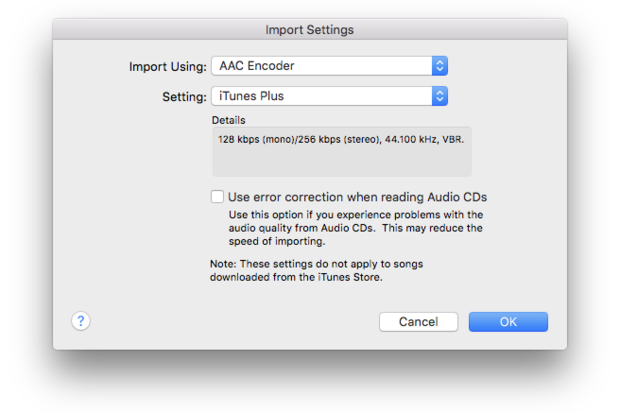
Before converting, make sure the AAC encoder is selected in your import settings. The conversion process will create a new AAC version of each track while keeping the original Apple Lossless file unchanged in your library.
Note: This method is designed for DRM-free local files or eligible purchased songs in your library, rather than Apple Music streaming tracks. Also, converting from Apple Lossless to AAC reduces file size but involves some loss of audio data, as AAC is a lossy format.
How to Convert Apple Lossless to AAC
Step 1. Install and Launch iTunes on your computer.
Step 2. Choose "Edit > Preferences > General > Import Settings".
Step 3. In the pop-up window, choose "AAC Encoder" in the drop-down menu of "Import Using". Then click "OK" to confirm your choice.
Step 4. Navigate to your library, and select the Apple Lossless songs you want to convert. Then click "File > Convert > Create AAC Version" to initiate the conversion.
Method 2. Convert Apple Music Streaming Songs to AAC via TuneFab
If your goal is to download streaming Apple Music songs and save them to AAC, the situation is different from converting local files. Apple Music streaming tracks are not stored as standard audio files, so they cannot be processed using the Apple Music app or iTunes conversion feature.
To export these tracks as AAC files for playback on other devices, you need a tool that can process Apple Music content and convert it into standard audio formats. TuneFab Apple Music Converter is designed for this scenario, allowing you to convert Apple Music songs, albums, and playlists into AAC (.m4a) files for offline use.
100% Secure
100% Secure
Key Features of TuneFab Apple Music Converter
- Convert Apple Music tracks to AAC (.m4a) and other common formats
- Support batch conversion of playlists, albums, and multiple songs
- Customize output settings such as bitrate, sample rate, and output folder
- Preserve ID3 tags, including title, artist, album, and artwork
- Built-in Apple Music web player for direct browsing and selection
How to Convert Apple Music to AAC
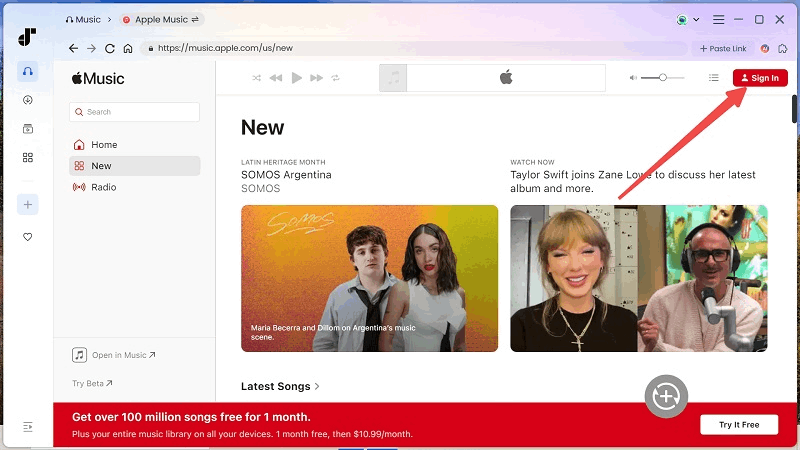
Step 1. Download, install, and run TuneFab Apple Music Converter. On the main interface, choose "Apple Music" to enter, and log in to the built-in Apple Music web player with your Apple Music account.
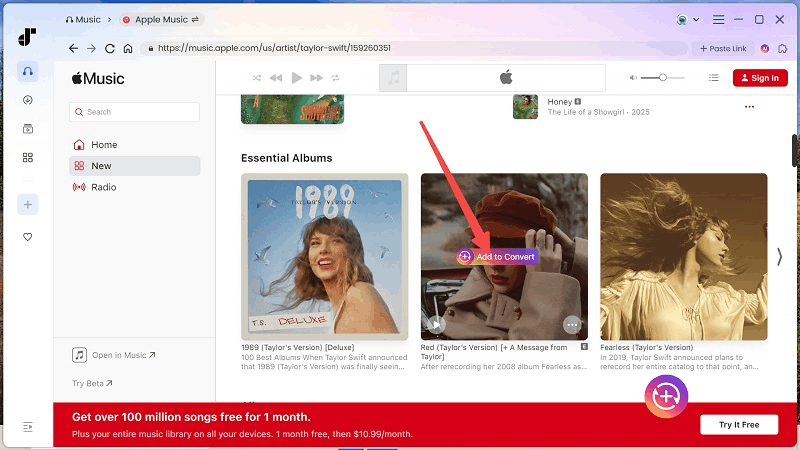
Step 2. Browse or search for the songs, albums, or playlists you want, then click the floating "Add to Converter" button to add them to the conversion list.
Step 3. For each song, you can select AAC (.m4a) as the output format. Also, you can tweak more output settings like output location, sample rate, bitrate, etc.
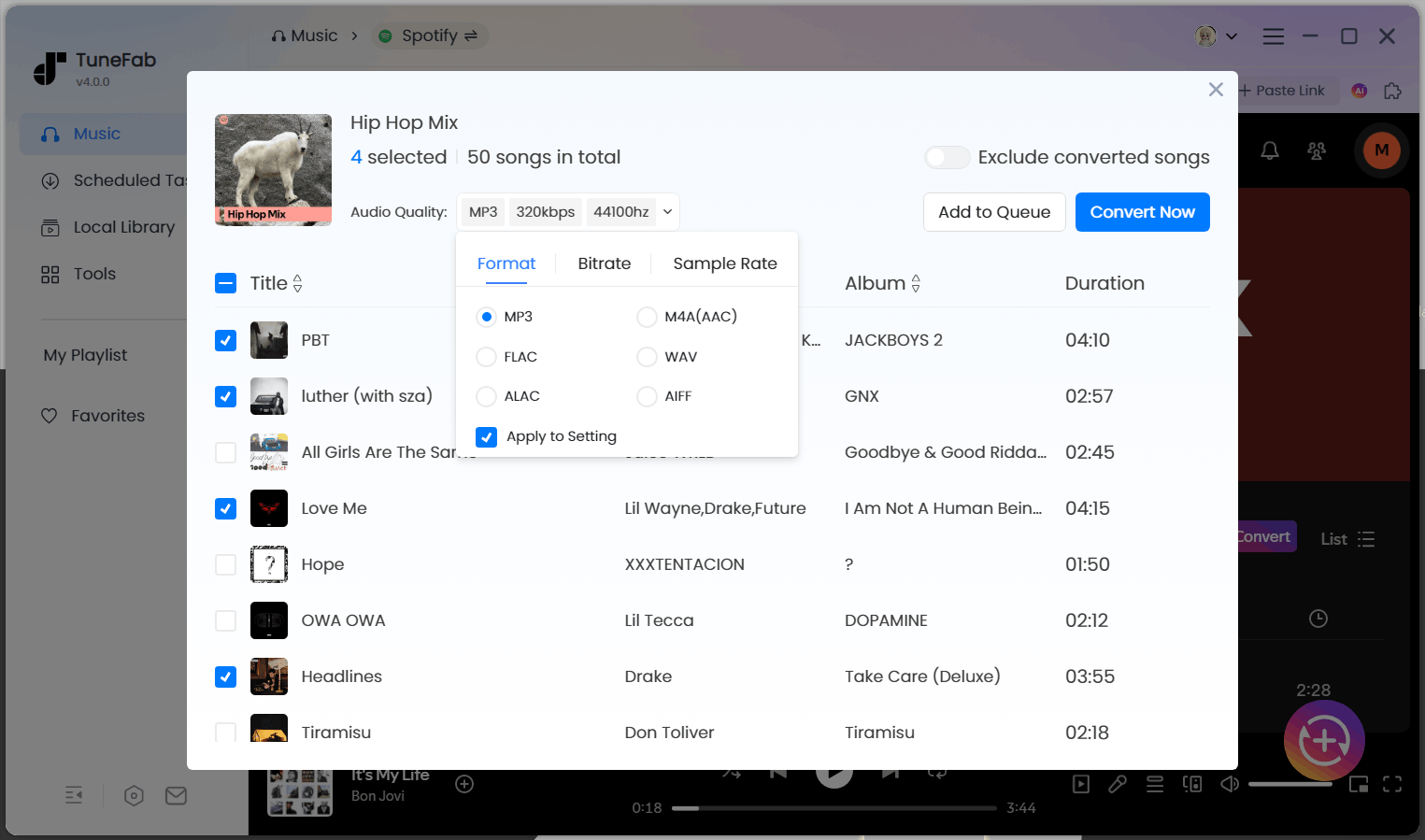
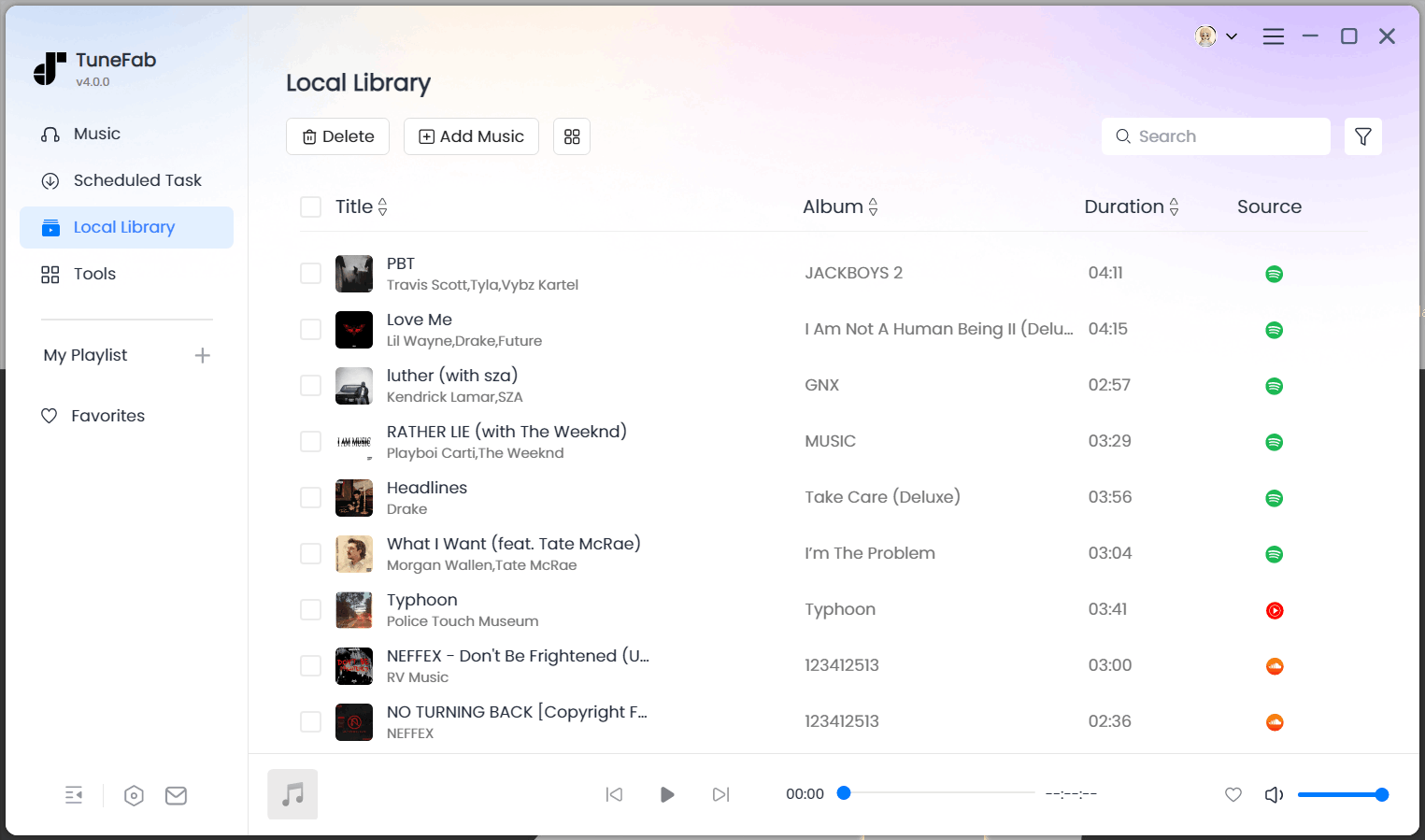
Step 4. After all the adding and settings, simply click "Convert Now" to start the batch conversion. Once finished, the converted Apple Music AAC files will be saved locally, and you can find them on the "Library" tab.
Tips: If you want to convert Apple Music to formats other than AAC, check the tutorials below.
Bonus Tips: Best AAC Settings (Bitrate and Encoder Explained)
When converting Apple Lossless to AAC, choosing the right settings can help you balance file size and audio quality. Since AAC is a lossy format, the output quality largely depends on the bitrate you select.
For most users, a bitrate of 256 kbps (AAC) is considered a good standard, offering high-quality sound with significantly reduced file size. If you prioritize saving more space, 128 kbps can be sufficient for casual listening, while 192 kbps provides a balanced option between quality and size.
In addition to bitrate, Apple Music and iTunes typically use the built-in AAC Encoder, which is optimized for compatibility across Apple devices and widely supported platforms. In most cases, you can keep the default encoder settings unless you have specific requirements.
- 256 kbps: Best for high-quality listening and long-term use
- 192 kbps: Balanced choice for everyday playback
- 128 kbps: Smaller size, suitable for limited storage or casual use
Choosing the appropriate settings depends on how you plan to use your music. If you mainly listen on mobile devices or use Bluetooth headphones, higher bitrates may not always bring noticeable improvements, while taking up more space.
FAQs About Converting Apple Lossless or Apple Music to AAC
How do I convert Apple Music to AAC?
To convert Apple Music to AAC, the method depends on the type of content. For Apple Music streaming tracks, you need TuneFab Apple Music Converter to export them as AAC files for offline use. If your music is already stored locally or in Apple Lossless format, you can use the Apple Music app on Mac or iTunes on Windows to convert it to AAC by selecting the AAC encoder in the import settings and creating an AAC version.
How to convert ALAC to AAC in iTunes?
To convert Apple Lossless (ALAC) to AAC in iTunes, first go to "Edit > Preferences > General > Import Settings" and select "AAC Encoder". Then choose the songs you want in your library and click "File > Convert > Create AAC Version". iTunes will generate a new AAC copy while keeping the original file unchanged.
Is AAC the same as Apple Lossless?
No, AAC and Apple Lossless (ALAC) are different formats. ALAC is a lossless format that preserves all original audio data, while AAC is a lossy format that compresses audio to reduce file size. As a result, AAC files are much smaller but involve some loss of audio quality compared to Apple Lossless.
Conclusion
Converting Apple Lossless to AAC is a practical way to reduce file size and improve compatibility across devices, especially for mobile playback and everyday listening. While Apple Lossless preserves full audio quality, AAC offers a more efficient balance between sound and storage, making it a popular choice for managing large music libraries.
The right method depends on your situation. If you want to convert Apple Lossless to AAC files stored locally, you can use the Apple Music app or iTunes with the AAC encoder. For Apple Music streaming tracks, a dedicated solution like TuneFab Apple Music Converter is required to convert Apple Music to AAC for offline use. By choosing the appropriate approach and settings, you can optimize both audio quality and storage based on your needs.
TuneFab Apple Music Converter
One click to convert Apple Music to AAC with lossless quality.

